
Blockchain Technology Trends to Watch in 2026
From tokenized assets and stablecoin rails to MiCA-era compliance and AI provenance — the blockchain trends enterprise teams should plan for in 2026.
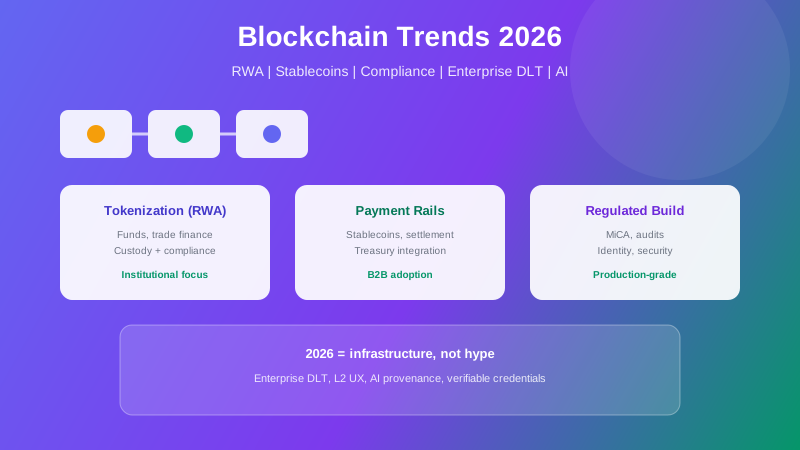
Between 2024 and 2026, blockchain moved further away from speculative hype and closer to infrastructure other systems plug into. Enterprise buyers now ask different questions: not "which chain will win?" but "where does a ledger reduce reconciliation cost, settlement time, or fraud risk — and what compliance guardrails do we need?"
This article outlines blockchain technology trends worth watching in 2026 for product owners, architects, and engineering leaders planning builds — with emphasis on regulated industries, B2B platforms, and production-grade delivery rather than experimental DeFi alone.
1. Tokenization of Real-World Assets (RWA)
Thesis: The dominant institutional narrative in 2026 is on-chain representation of off-chain assets — not new cryptocurrencies for their own sake.
Tokenization pilots from 2023–2024 matured into production programs: tokenized money-market funds and treasuries, trade-finance instruments, real-estate fractionalisation (where regulation allows), and private credit allocations. Banks, asset managers, and infrastructure providers treat blockchains as settlement and registry layers with familiar audit requirements.
What changed since 2024:
- Custody, transfer agent, and KYC workflows are part of the product — not afterthoughts
- Issuance platforms integrate with existing core banking and fund admin systems
- Investors expect daily NAV, redemption rules, and jurisdictional eligibility encoded in process — not only in smart contracts
Build implication: RWA projects need legal entity design, investor onboarding, and reporting pipelines alongside smart contracts. Permissioned chains and hybrid architectures (on-chain settlement + off-chain data room) remain common.
2. Stablecoins and Blockchain Payment Rails
Thesis: Stablecoins shifted from trading collateral to cross-border settlement and treasury rails — especially for companies with multi-currency operations and slow correspondent banking.
In 2026, enterprises evaluate stablecoin flows for B2B payouts, marketplace escrow, and treasury experimentation — always alongside FX, tax, and sanctions screening. Payment-focused L2s and dedicated payment chains compete on finality time, fee predictability, and issuer transparency.
Watch for:
- Integration with ERP and accounting ( reconciliation by hash, not manual CSV )
- Clear issuer attestation and reserve reporting
- Programmable payment rules ( milestones, escrow release ) without exposing treasury keys to application bugs
Build implication: Treat payment rails like any financial integration — idempotency, ledger reconciliation, and incident playbooks — whether settlement is on-chain or hybrid.
3. Regulation as Product Requirement (MiCA and Beyond)
Thesis: In 2026, compliance is a feature, not a launch blocker to defer. The EU Markets in Crypto-Assets (MiCA) framework is in force; other jurisdictions converged toward licensing, VASP rules, travel rule enforcement, and securities-style disclosure for token offerings.
Enterprise impact:
- Whitepapers and token classifications matter for public launches
- Custody and key management must map to organizational controls
- Privacy ( GDPR ) and on-chain transparency pull in opposite directions — design choices must be documented
Build implication: Engage legal and compliance early. Engineering delivers audit logs, role separation, upgrade governance, and data minimization — patterns familiar from fintech software development but applied to token lifecycle and wallet operations.
4. Enterprise DLT: Permissioned Chains and Hybrid Architectures
Thesis: Most enterprise programs still choose permissioned distributed ledgers ( Hyperledger Fabric, Besu private networks, Corda-style models ) or hybrid designs: public-chain anchors for notarisation, private layers for business data.
Use cases with sustained traction in 2026:
- Supply chain provenance and document exchange
- Trade finance and letter-of-credit digitisation
- Inter-enterprise workflows where multiple parties share state but do not trust a single database owner
What faded: "Blockchain for blockchain's sake" without a clear multi-party trust problem. Successful projects name the consensus boundary — who validates, who reads, who administers membership.
Build implication: Start from integration topology ( ERP, WMS, customs APIs ) and throughput targets. Smart contracts orchestrate; they rarely replace entire back-office systems.
Technical deep dive: Hyperledger and Corda in 2026
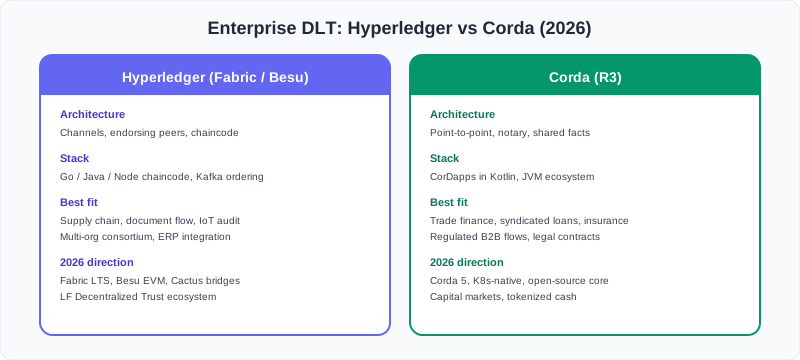
Among permissioned platforms, Hyperledger and Corda remain the two stacks enterprise architects compare most often. They solve overlapping problems — multi-party trust without a single database owner — but with different privacy models, developer stacks, and industry gravity. The diagram below summarises how teams typically split responsibilities in 2026.
Hyperledger: Fabric, Besu, and the LF Decentralized Trust ecosystem
Hyperledger (now part of the Linux Foundation Decentralized Trust umbrella) matured as a modular toolkit rather than a single product. For greenfield enterprise networks in 2026, three lines matter most:
| Component | Role in 2026 | Typical engineering notes |
|---|---|---|
| Hyperledger Fabric | Default for multi-organisation consortiums with channel-level data isolation | Chaincode as external service ( Fabric 2.x+ ), endorsement policies per chaincode, private data collections for PII |
| Hyperledger Besu | EVM-compatible private networks when teams want Solidity tooling inside a permissioned perimeter | Useful when public Ethereum patterns must be reused without public-chain exposure |
| Hyperledger Cactus | Interop between Fabric, Besu, and other ledgers | Reduces one-off bridge code when hybrid or phased migration is planned |
How Fabric evolved (2024–2026):
- Operational maturity: LTS release trains, clearer upgrade paths for orderers and peers, and production patterns for HSM-backed identities
- Privacy by design: Private data collections and channel policies remain the primary way to keep competitor data off shared ledgers while still agreeing on hashes
- Integration-first delivery: Event listeners, off-chain databases for query-heavy UIs, and CA/certificate rotation aligned with enterprise IAM — not “everything on ledger”
- Interop realism: Cactus and similar adapters acknowledge that most enterprises run more than one DLT ( legacy Fabric network + new Besu pilot, for example )
Fabric chaincode model (conceptual):
Client app → Fabric SDK → endorse peers (simulate chaincode)
         → ordering service → commit on channel ledger
         → off-chain index / ERP sync via events
Chaincode is commonly implemented in Go, Java, or Node.js. Teams choose Go for performance-critical logistics flows; Java where alignment with existing enterprise backends matters.
Primary use zones for Hyperledger Fabric / Besu:
| Domain | Why Hyperledger fits | Example patterns |
|---|---|---|
| Supply chain & retail | Many participants, shared provenance, competitor-sensitive pricing off-channel | SKU traceability, recall workflows, audit trails |
| Document flow & e-government | Immutable document hashes, multi-agency verification | Status transitions, signature chains, integration with document management |
| Construction & field operations | IoT + inspection data anchored for dispute resolution | Milestone sign-off, subcontractor accountability |
| Industrial IoT audit | High write volume with hashed telemetry | Device attestations, maintenance logs synced to ERP |
Smartym Pro has delivered Hyperledger Fabric solutions in production-oriented programs — for example blockchain-enabled document flow and construction process management — where consortium membership, channel design, and ERP integration were as critical as chaincode logic.
Corda: point-to-point privacy for regulated financial workflows
Corda (maintained by R3 and the open-source community) targets regulated B2B transactions where participants must see only their counterparty-related state — not a global replicated ledger of all network activity.
How Corda evolved (2024–2026):
- Corda 5 architecture: Kubernetes-native, microservice-style nodes, improved ops for banks and vendors running managed networks
- Open-source core with commercial distributions for supported deployments — lowering lock-in risk versus early enterprise-only models
- CorDapps in Kotlin on the JVM — natural fit for financial institutions with Java/Kotlin estates
- Notary pools and transaction finality models tuned for legal-grade timing ( when did ownership transfer? )
- Stronger network governance tooling for regulated industries upgrading from PoC to always-on production
Corda privacy model (conceptual):
Party A ←→ Party B   (shared transaction only between them)
Notary service       (uniqueness / ordering, not full data replication)
Network map / identity — permissioned membership
Unlike Fabric channels ( shared ledger segment among a defined group ), Corda emphasises need-to-know replication: unrelated participants do not receive transaction payload they are not party to.
Primary use zones for Corda:
| Domain | Why Corda fits | Example patterns |
|---|---|---|
| Trade finance & supply-chain finance | Multi-bank visibility with strict confidentiality | Letters of credit, invoice financing, payment obligations |
| Capital markets & syndicated lending | Complex multi-party agreements, legal wording in flows | Loan participation, covenant tracking, settlement instructions |
| Insurance ( bordereaux, claims ) | P2P data exchange between insurers, brokers, reinsurers | Policy state, claims hand-offs with audit trail |
| Tokenised cash & regulated settlement | Overlap with RWA trend inside banking networks | On-network delivery vs payment with identity-bound nodes |
Corda is often selected when legal and compliance teams require that sensitive fields never appear on nodes of non-participating institutions — even within the same “network brand.”
Hyperledger vs Corda: selection guide
| Criterion | Lean Hyperledger (Fabric/Besu) | Lean Corda |
|---|---|---|
| Data visibility | Shared channel among defined orgs; private collections for subsets | Point-to-point; minimal shared global state |
| Developer stack | Go / Java / Node chaincode; Besu adds Solidity | Kotlin CorDapps, JVM integration |
| Industry bias | Logistics, manufacturing, govtech, cross-industry consortia | Banking, insurance, capital markets |
| Throughput pattern | Batch + event-driven sync to ERP | Transaction-centric financial workflows |
| Interop need | Cactus, Fabric↔Besu hybrids | Often single-network; bank-grade APIs outward |
| Smartym experience | Multiple Fabric case deliveries | Blockchain development services across stacks — stack choice follows trust model |
Hybrid reality in 2026: Large groups run Fabric for operational supply chain and participate in Corda-based finance networks for settlement — connected via APIs, not a single chain. Architecture reviews should assume integration hubs, not one ledger to rule them all.
Build checklist (both stacks):
- Define membership MSP / identity and rotation before chaincode or CorDapp sprints
- Plan off-chain query models — UIs rarely read ledger state directly at scale
- Document upgrade governance ( who signs chaincode/CorDapp upgrades, timelocks, rollback )
- Align GDPR and retention — on-ledger hashes vs off-ledger PII storage
- Run PoC on production-like ops ( K8s, HSM, monitoring ) early — permissioned DLT failures are usually operational, not consensus-theoretical
For stack selection workshops and PoC delivery on Hyperledger or Corda, see our blockchain development services or contact the team with your consortium map and integration inventory.
5. Layer 2 Maturity and Chain Abstraction
Thesis: For public-chain applications, Layer 2 networks became the default execution environment in 2026 — not an experimental optimization.
Rollups on Ethereum and similar stacks offer lower fees and higher throughput while inheriting L1 security assumptions. Account abstraction ( smart accounts, gas sponsorship, session keys ) improves consumer and B2B UX — reducing wallet friction that blocked adoption in 2022–2023.
Engineering focus:
- Cross-L2 liquidity and bridging remain high-risk — prefer canonical bridges, official interoperability stacks, or minimise cross-chain scope
- Choose L2 based on ecosystem tooling, sequencer decentralisation roadmap, and exit guarantees — not headline TPS alone
- Observability across L1/L2 ( deposits, withdrawals, reorgs ) belongs in production runbooks
6. AI and Blockchain Convergence
Thesis: AI adoption created a new demand for provenance, attribution, and verifiable workflows — areas where tamper-evident logs and signed attestations help.
Trends in 2026:
- Training data lineage and consent records anchored for audit
- Agent commerce experiments — micropayments and policy-bound wallets for autonomous services
- Verifiable credentials paired with model or dataset attestations ( not "AI on blockchain" hype — specific trust gaps )
Build implication: Combine off-chain compute with on-chain commitments ( hashes, signatures, timestamps ). Most value is in integrity and audit, not running inference on-chain.
7. DeFi: Institutional Primitives, Not Retail Yield Chasing
Thesis: DeFi in 2026 emphasises composable financial plumbing inside regulated perimeters — tokenised deposits, institutional lending pools, on-chain repo experiments — rather than anonymous yield farming.
Retail DeFi still exists but enterprise interest centres on:
- Automated market making for tokenised assets with compliance gates
- Settlement nets and DvP ( delivery versus payment ) patterns
- Integration with traditional custody and risk systems
Security lesson from 2024–2025: Protocol exploits and bridge failures reinforced formal verification, bug bounties, timelocks, and gradual rollout — non-negotiable for institutional participants.
8. Security, Custody, and Smart Contract Assurance
Thesis: Security maturity separates production programs from demos. Audits alone are insufficient; teams expect continuous monitoring, incident response, and key ceremony documentation.
2026 baseline practices:
- Multi-sig or MPC custody with defined quorum and geographic separation
- Separate environments for upgradeable proxy admin keys
- On-chain monitoring ( anomaly detection, pause mechanisms ) with legal review
- Third-party audits plus internal threat modelling before mainnet
Smartym Pro's blockchain development services include smart contract engineering, integration layers, and security-focused delivery for wallets, marketplaces, and enterprise DLT — aligned with case work in trading platforms, document flow, and construction monitoring in our portfolio.
9. Digital Identity and Verifiable Credentials
Thesis: Self-sovereign identity matured into practical verifiable credentials — especially in the EU with digital identity wallet initiatives and cross-border trust frameworks.
Enterprise use cases in 2026:
- Supplier and partner onboarding with reusable credentials
- Age or licence checks without centralised data hoarding
- Employee and contractor access tied to issuers customers already trust
Build implication: Identity stacks combine W3C VC standards, wallet SDKs, and revocation registries — often without putting personal data on a public chain.
10. CBDCs and Wholesale Settlement Experiments
Thesis: Retail CBDCs progress unevenly by country; wholesale CBDC and interbank tokenised deposit experiments accelerate where central banks pilot programmability and faster settlement.
For most private-sector builders, CBDC impact appears as:
- New settlement endpoints and API standards from banking partners
- Competition with stablecoin rails for cross-border B2B flows
- Requirements to support both traditional and tokenised money movement in treasury systems
What to Prioritise in 2026: A Practical Checklist
| If your goal is… | Prioritise… |
|---|---|
| Faster B2B settlement | Stablecoin / tokenised deposit rails + reconciliation |
| New investor products | RWA tokenization + custody + regulatory classification |
| Multi-party supply chain trust | Permissioned DLT + ERP integration |
| Consumer on-chain app | L2 + account abstraction + compliance UX |
| AI product trust | Provenance anchoring + credential-based access |
Avoid starting with chain selection. Start with trust boundary, regulatory class, and integration map — then pick infrastructure.
Practical Map: Project Type to Skill Stack
There is no single "blockchain developer" profile in 2026. Project shape drives the stack — and most production effort still sits in integration, compliance, and operations, not only in chaincode or smart contracts.
The table below is a practical hiring and roadmap reference for engineering leaders scoping teams. It reflects what we see on enterprise, fintech-adjacent, and regulated programs — not generic NFT marketplace builds.
| Project type | Primary platform | Core engineering skills | Integration & ops | Compliance / security |
|---|---|---|---|---|
| Supply chain & retail traceability | Hyperledger Fabric | Go or Java chaincode, channel design, private data collections | ERP / WMS APIs, event listeners, off-chain index | Multi-org membership, audit trails |
| Document flow & e-government | Hyperledger Fabric | State models, endorsement policies, document hash anchoring | DMS, signature services, workflow engines | Retention, GDPR, role-based ledger access |
| Construction & field operations | Hyperledger Fabric | IoT/event ingestion patterns, milestone chaincode | Mobile backends, project management tools | Dispute-ready immutable audit — see construction blockchain cases |
| Trade finance & syndicated lending | Corda | Kotlin CorDapps, flows, notary models | Core banking APIs, SWIFT-adjacent messaging | Point-to-point privacy, legal agreement alignment |
| Insurance ( bordereaux, claims hand-off ) | Corda | Shared facts between insurers, brokers, reinsurers | Policy admin systems, batch reconciliation | Regulated data sharing, not global ledger exposure |
| Tokenized fund / RWA platform | Public L2 or private EVM + off-chain | Solidity, Foundry/Hardhat, allowlists, upgrade governance | Fund admin, custody, KYC/AML pipelines, NAV reporting | Securities classification, investor eligibility — overlap with fintech compliance patterns |
| B2B stablecoin / payment rails | L2 or banking network APIs | Smart contracts or bank SDKs, idempotency, webhook handling | ERP, treasury, accounting reconciliation | Sanctions screening, travel rule where applicable |
| Consumer on-chain product | Ethereum L2 | Solidity, gas tuning, indexing ( subgraph or custom ) | Wallet UX, ERC-4337 / smart accounts, backend auth | User protection, geo restrictions, audit |
| Wholesale CBDC / bank pilot integration | Bank-provided APIs | Java or Spring integration services ( common in banking stacks ) | Legacy core, settlement nets | Central bank and partner SLAs, not greenfield chain choice |
Skills that transfer across project types
Regardless of row in the table, senior contributors on current blockchain programs usually combine:
Architecture
- Clear split: what is on-ledger ( hashes, state transitions ) vs off-ledger ( PII, heavy queries, UX )
- Consensus / membership model documented before sprint one
Backend & integration
- Event-driven sync, idempotent handlers, observability — same as Java backend or web platform delivery
Security & production
- Key ceremony, upgrade governance, monitoring, incident playbooks — especially for bridges, admin keys, and custody
Compliance literacy
- Enough to implement controls ( audit logs, data minimization, role separation ) without pretending to replace legal counsel
What is less central in 2026 enterprise demand
- Greenfield L1 / custom consensus — mostly infrastructure vendors
- NFT-first marketplaces without regulated asset or loyalty utility — niche volume
- "Web3 frontend only" without backend, indexing, and security — rare in B2B
- DeFi yield products outside institutional or sandboxed contexts
If you are staffing a program, match the first hire to the trust model ( Fabric/Corda vs EVM ), then add integration and security depth — not the reverse.
Conclusion
Blockchain technology trends in 2026 favour utility over speculation: tokenized assets, regulated payment rails, enterprise DLT, mature L2 UX, AI provenance, and security discipline. Teams that treat compliance, custody, and reconciliation as core engineering — not legal afterthoughts — ship systems that survive audit and scale.
Whether you are exploring tokenization, a permissioned consortium chain, or a public L2 application, align architecture with business trust boundaries first. Smartym Pro supports blockchain development from smart contracts and wallets to integration with existing enterprise systems — and related domains such as web platforms when your product spans on-chain and off-chain UX.
Planning a blockchain initiative in 2026? Tell us about your project — we will help you scope architecture, compliance touchpoints, and a realistic first release.