
Code Quality Review and Control as Part of the Smartym Pro Software Development Life Cycle
How Smartym Pro embeds code quality review, engineering standards, and automated control gates across discovery, development, CI, release, and post-release support — with full transparency for clients.
When you buy engineering capacity — whether through a dedicated development team, a fixed-scope project, or staff augmentation — code quality is rarely the first topic in the sales call. It should be one of the first topics in the delivery contract.
Poor review discipline shows up months later: slow releases, fragile refactors, security findings in audit, and a codebase your next vendor refuses to touch. Strong code quality review and control is how a partner proves they are building future-proof software, not just closing tickets.
This article explains how Smartym Pro treats quality as part of the SDLC — the standards we apply, the review workflows we run, the automation we enforce, and how clients stay in the loop. It complements our development approach page, where we describe workflow, transparency, and tooling at a glance.
Why Quality Control Belongs in the SDLC — Not at the End
Treating quality as a final QA phase creates predictable failure modes:
| Symptom | Root cause | What we do instead |
|---|---|---|
| "It worked in the sprint demo" but breaks in production | No release gates, weak test coverage | CI blocks merge on tests + critical static analysis |
| Every change is risky | No conventions, no review culture | Documented standards + mandatory peer review |
| Client cannot assess progress | Opaque repo, summary-only reporting | Repo access, sprint reports, demo reviews |
| Technical debt compounds silently | No refactor budget in backlog | Preventive maintenance in post-release stage |
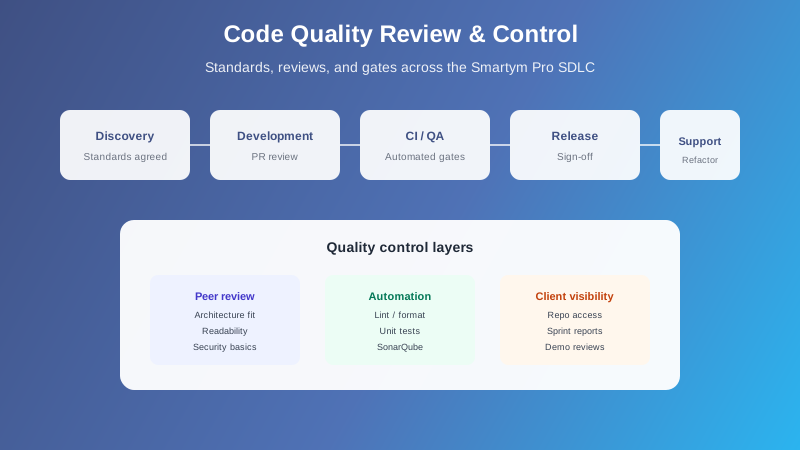
Quality is a continuous property of how we work — aligned with the four stages on our approach: Discovery, Development, Deployment, and Post-release Support.
Discovery: Agree Standards Before the First Commit
Before implementation starts, we align with you on non-functional expectations that shape every review afterward:
- Technology stack and version policy ( LTS runtimes, supported frameworks )
- Repository layout — monorepo vs polyrepo, branching model ( we commonly use Git Flow or trunk-based variants depending on release cadence )
- Definition of Done — what "ready for merge" and "ready for release" mean for this product
- Security and compliance constraints — data residency, logging, secrets handling ( see also our fintech regulatory checklist where relevant )
Outputs from discovery — estimation, roadmap, wireframes — matter for quality too. Ambiguous acceptance criteria produce ambiguous code. We push clarity upstream so review conversations stay technical, not political.
Development: How Code Review Works on Our Teams
During active development, every meaningful change goes through peer review before it reaches your mainline branch.
Pull request workflow
Typical flow on client-embedded teams:
- Engineer opens a PR against the agreed base branch
- Author provides context: ticket link, test notes, migration impact
- Reviewer ( peer or tech lead ) checks design fit, readability, tests, and security basics
- CI pipeline must pass before merge approval
- Merge only after at least one qualified approval ( two for high-risk areas — payments, auth, infra — when we agree that upfront )
Reviewers ask questions a maintainer would ask six months later: Can I understand this without the author in the room? Does it respect existing patterns? What breaks if we scale traffic 10×?
What we look for in review
| Area | Examples |
|---|---|
| Correctness | Edge cases, error handling, idempotency for integrations |
| Maintainability | Naming, module boundaries, duplication, comments only where intent is non-obvious |
| Tests | Unit coverage on business logic; integration tests on critical paths |
| Security | Input validation, authz checks, secret handling, dependency awareness |
| Observability | Logging without PII leaks, metrics on new flows where operations need them |
We do not use review as performance theatre. The goal is shared ownership of the codebase — especially important when you steer the backlog and we supply the capacity, as in dedicated team engagement.
Coding standards
Stack-specific linters and formatters run locally and in CI — ESLint/Prettier for TypeScript, Checkstyle or similar for Java, etc. Style debates do not belong in human review; automation handles formatting so reviewers focus on design.
For longer engagements we document project conventions in the repo ( CONTRIBUTING.md, ADRs for major decisions ) so onboarding stays fast when the team grows.
Automated Quality Gates: CI, Tests, and SonarQube
Human review does not scale alone. Our toolchain — visible on our approach — includes Git, Jira/Redmine, AWS, Slack, and SonarQube.
Continuous integration
CI runs on every PR and protected branch:
- Build — compile/bundle succeeds on the target environment matrix
- Unit and integration tests — failures block merge
- Static analysis — lint rules, type checks, dependency policy where configured
- SonarQube ( or equivalent ) — track bugs, vulnerabilities, code smells, coverage trends
We treat SonarQube as a trend and gate tool, not a vanity score. New critical issues block release; legacy debt is scheduled in the backlog rather than ignored.
QA beyond the pipeline
Automated UI tests, manual exploratory sessions, and staging verification sit between "merged" and "released." On deployment we configure crash reporting and analytics hooks so production signal feeds the next sprint — part of our Deployment stage on the approach page.
Release and Post-release: Quality Does Not Stop at Go-live
Release requires explicit sign-off against the Definition of Done: migration scripts tested, rollback path understood, release notes prepared.
In post-release support, quality work continues through:
- Corrective maintenance — defect fixes with the same review + CI discipline
- Preventive maintenance — refactoring for scalability, dependency updates
- Perfective maintenance — performance and UX improvements with measured outcomes
Clients on long-term dedicated team engagements often allocate a steady refactor budget so velocity stays high without trading away stability.
Transparency: How You Verify Quality Yourself
We describe transparency mechanisms on our approach; they matter directly for quality assurance:
- Repository access — inspect branches, PR history, and review comments
- Demo presentations after each sprint — validate behaviour, not only slide decks
- Detailed reports — hours, completed tasks, scope completion percentage
- Direct communication with engineers — assess depth beyond the PM layer
If you cannot see how code is reviewed, you are buying a black box. We prefer the opposite.
How This Fits Engagement Models
Quality control adapts to how you engage us, not the other way around:
| Engagement | Quality ownership |
|---|---|
| Dedicated team / augmentation | You own product priorities; we enforce engineering standards and review on our side; merges follow your release policy |
| Agile T&M product build | Shared backlog; we propose DoD; demos + reports each sprint |
| Fixed-scope waterfall | Quality criteria fixed at stage boundaries; acceptance per milestone |
Misalignment — e.g. expecting vendor-led QA depth while staffing augmentation-only — is a common source of disappointment. We clarify this during discovery and in articles like dedicated team vs project outsourcing.
AI-Assisted Development: Review Still Wins
We use AI-assisted development where it speeds drafting, tests, and documentation — but merge authority stays human. Generated code goes through the same PR, CI, and security checks. See how AI accelerates delivery for where automation helps and where it does not replace review.
Practical Checklist for Buyers
Use this when evaluating any vendor — including us:
- Show me your PR template and review rules for a similar stack
- What fails a build? Tests only, or also coverage/static analysis thresholds?
- Who approves merges to production branches?
- Can I access the repo and CI history?
- How is tech debt tracked after go-live?
If answers are vague, expect vague code.
Summary
Code quality review and control at Smartym Pro is not a slide — it is embedded in discovery standards, mandatory peer review, CI and SonarQube gates, structured QA, and client-visible workflows across the full SDLC.
That is how we deliver what we promise on our approach: not just code, but future-proof, maintainable software with stress-free development.
Want to see how this works on your product? Get in touch — we can walk through our workflow, tooling, and sample review practices on a call.