
Web Development Trends to Watch in 2025
Enterprise web development trends for 2025 — full-stack frameworks, Core Web Vitals, AI features, edge backends, security, and observability for production teams.
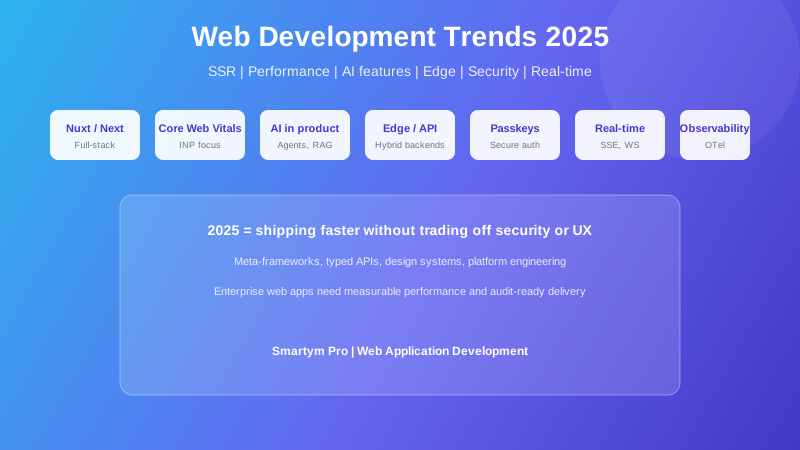
By 2025, web development for enterprise and B2B products is less about picking the newest JavaScript framework and more about predictable delivery: fast UX, secure integrations, measurable performance, and platforms teams can operate for years. Marketing sites and internal dashboards share the same baseline — SSR for SEO, typed APIs, CI/CD, and observability — even when product complexity differs.
This article outlines web development trends worth watching in 2025 for product owners, architects, and engineering leaders planning builds — with emphasis on production-grade web application development rather than demo-only stacks.
1. Full-Stack Meta-Frameworks as the Default
Thesis: Teams standardise on meta-frameworks that unify routing, data fetching, deployment, and often API routes — instead of hand-rolled Webpack + Express setups.
In 2025, Nuxt 4 ( Vue ) and Next.js ( React ) dominate greenfield and replatforming decisions for content-heavy and SaaS-style products. Astro remains strong for marketing + docs with islands architecture; SvelteKit wins where bundle size and simplicity are primary constraints.
What changed since 2023–2024:
- Server Components / hybrid rendering moved from experiment to default pattern for data-heavy pages
- File-based routing + typed data loaders reduce boilerplate for BFF-style endpoints
- Built-in image and font optimisation is expected, not optional
Build implication: Choose the framework that matches your team’s skills and hosting model ( Node server, serverless, static + edge ). Replatforming is justified when operational cost or SEO/performance SLAs fail — not because a framework release note dropped.
2. Performance as a Product Requirement (Core Web Vitals)
Thesis: Interaction to Next Paint (INP) replaced FID as the responsiveness metric teams must budget for — especially on data tables, filters, and multi-step forms common in B2B apps.
Performance in 2025 is tracked like uptime:
- Lab + field data in CI ( Lighthouse CI, RUM )
- Route-level budgets for JS payload and long tasks
- Partial hydration / islands where full SPA hydration is unnecessary
Build implication: Performance reviews belong in definition of done — alongside accessibility and security. Pair engineering work with UI/UX principles so perceived speed and visual clarity align.
3. AI Features Inside Web Products (Not Only in the IDE)
Thesis: AI moved from developer tooling to user-facing product features — search, summarisation, classification, and agent-assisted workflows embedded in the web UI.
2025 products commonly combine:
- Hosted LLM APIs or private deployments for sensitive domains
- RAG over help docs, contracts, or ticket history
- Human approval before irreversible actions ( payments, external email )
This is distinct from AI-driven development ( how teams build software ) — here AI is part of the product experience. Architecture must cover auth, rate limits, prompt logging, and fallback when models fail.
Build implication: Scope AI features as vertical slices with measurable outcomes — not a chat widget on every page. See custom AI agents for workflow-oriented patterns.
4. Edge Compute and Hybrid Backends
Thesis: Edge functions handle latency-sensitive reads, geo routing, and auth checks; core business logic often stays on containers or managed services for long transactions and database consistency.
Hybrid patterns in 2025:
- Edge: JWT validation, A/B flags, lightweight transforms
- Region-local API: CRUD, reporting, batch jobs
- Queue workers: imports, notifications, document processing
Build implication: Document data residency and timeout limits before placing logic at the edge. Not every endpoint belongs on serverless — custom vs off-the-shelf decisions still apply when integrations dominate scope.
5. API-First Backends and Typed Contracts
Thesis: OpenAPI-first REST, GraphQL for flexible product graphs, and tRPC / typed RPC inside full-stack monorepos reduce integration bugs between frontend and backend teams.
Enterprise programs favour:
- Versioned public APIs with deprecation policy
- BFF layer when multiple clients ( web, mobile, partners ) need different shapes
- Contract tests in CI so mobile and web do not drift
Build implication: Generate client types from schemas; treat breaking API changes as release events, not silent deploys.
6. Security and Supply Chain by Default
Thesis: Passkeys ( WebAuthn ), stricter Content Security Policy, and dependency scanning ( SBOM ) are baseline — not stretch goals for regulated or B2B SaaS.
2025 security checklist for web teams:
- OIDC / OAuth 2.1 patterns for SSO; secrets in vaults, not repos
- SAST + SCA in CI; blocked merges on critical CVEs where policy requires
- Session fixation and CSRF protections on cookie-based flows
- Audit logs for admin and data-export actions
Build implication: Security reviews early in architecture — especially when web apps touch fintech-adjacent flows or personal data.
7. Real-Time and Collaborative UX
Thesis: Users expect live updates — status dashboards, notification feeds, co-editing hints — without full page reloads.
Common 2025 patterns:
- SSE for server-to-client streams ( simpler than WebSockets for one-way )
- WebSockets for bidirectional collaboration
- Optimistic UI with reconciliation when server state returns
Build implication: Define reconnection, backoff, and idempotency before adding real-time channels. Load-test fan-out early for multi-tenant SaaS.
8. Design Systems and Accessible UI at Scale
Thesis: Design tokens + component libraries ( internal or headless primitives ) speed delivery and keep accessibility consistent across squads.
WCAG-oriented patterns — focus order, contrast, keyboard paths, live regions — are enforced through linting and visual regression, not manual checklist at release only.
Build implication: Invest in a shared design system when three or more teams ship the same product surface. Link design decisions to UI/UX fundamentals for content and layout, not only components.
9. Observability and Platform Engineering
Thesis: OpenTelemetry, structured logging, and internal developer portals ( templates, golden paths, service catalog ) shorten time-to-production for new services.
2025 platform expectations:
- Trace IDs from browser through BFF to database
- Error budgets tied to release cadence
- Preview environments per pull request for stakeholder review
Build implication: Observability is not “phase 2.” Instrument from the first production slice — especially for dedicated team engagements where handover to client ops is planned.
10. Modular Frontends for Large Organisations
Thesis: Micro-frontends and module federation remain relevant when multiple teams ship into one shell — portals, ERP-style UIs, partner dashboards.
Trade-offs are well understood in 2025:
- Pros: Independent deploys, team autonomy
- Cons: Shared dependency versions, performance overhead, UX consistency risk
Build implication: Prefer a modular monolith or single meta-framework app until team boundaries truly require separate deployables.
Stack Layers — Practical Reference
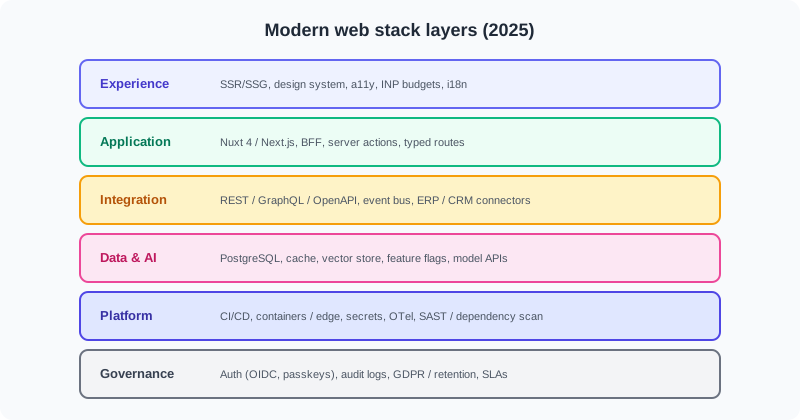
Use this as a roadmap conversation tool, not a mandatory blueprint — regulated clients may require on-prem segments; content sites may omit AI and real-time layers entirely.
| Trend | Primary beneficiary | Typical mistake |
|---|---|---|
| Meta-frameworks | Teams shipping SEO + app in one repo | Rewriting solely for hype |
| INP / CWV | Conversion-sensitive B2B | Optimising lab scores only |
| AI in product | Support, ops, knowledge work | No approval gates |
| Edge hybrid | Global latency | Putting transactions at edge |
| Typed APIs | Multi-client products | Undocumented breaking changes |
| Passkeys / CSP | B2B SaaS, regulated | Bolt-on security at end |
| Real-time | Dashboards, collaboration | No reconnect strategy |
| Design system | Multi-squad products | One-off page exceptions |
| Observability | Long-lived platforms | Logs without traces |
| Micro-frontends | Very large orgs | Premature split |
How Smartym Pro Helps
We deliver custom web applications — from marketing and content platforms to complex B2B portals — using stacks aligned with these 2025 trends: Nuxt/Vue, React/Next where appropriate, typed APIs, CI/CD, and production observability.
Typical engagement shapes:
- Greenfield product — architecture, design system seed, first production release
- Modernisation — SSR migration, performance remediation, API consolidation
- AI-augmented web — RAG search, agent workflows, admin tooling alongside AI development
Choose the right engagement model for your roadmap — fixed scope for a MVP slice, dedicated team for a multi-quarter platform.
Conclusion
Web development in 2025 rewards teams that treat performance, security, and operability as product features — while using meta-frameworks and typed integrations to ship faster. AI belongs in both how you build and what users experience, with governance in both places.
Avoid trend-chasing without a metric: pick one workflow ( e.g. checkout, onboarding, report export ), measure baseline INP and error rate, then apply the smallest stack change that moves the number.
Smartym Pro helps enterprises plan and build web applications that survive production — not only launch day. Explore web application development services or discuss your roadmap — we will help you prioritise trends against your constraints and team shape.
Planning a 2025 web build or replatform? Contact Smartym Pro — we will review your goals, stack options, and the fastest path to a measurable first release.