
AI-Driven Development: How AI Accelerates Software Delivery
How AI-driven development speeds up planning, coding, testing, and release in 2026 — with governance, metrics, and where human review still matters.
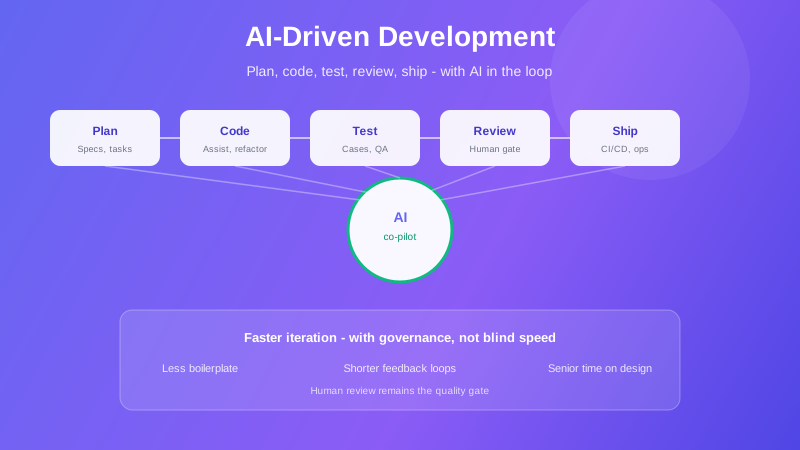
Competitive product teams still win on how fast they learn and ship — but "fast" in 2026 no longer means typing more code. AI-driven development means embedding artificial intelligence across the software lifecycle: planning, implementation, test, review, deployment, and operations — with human ownership of architecture, security, and product decisions.
This is not a replacement for engineering judgment. It is a shift in where senior time goes: less boilerplate, more design, integration, and quality gates. Used well, AI compresses iteration loops; used without governance, it compresses time to production incidents.
This article explains what AI-driven development means in practice, where it accelerates delivery, how to measure impact, and how it connects to custom AI in products versus AI inside the engineering process.
Why Speed Still Matters — and What Changed
The pressure is unchanged: competitors ship weekly, developer time is expensive, and MVPs must reach users quickly. What changed since 2024:
- Coding agents ( IDE assistants and autonomous task runners ) moved from autocomplete to multi-file edits and test generation
- Enterprise buyers ask about IP, data residency, and audit — not only "which Copilot license"
- Quality expectations rose with AI output volume — review and CI gates matter more, not less
AI can turn days of scaffolding into hours — but only when paired with clear acceptance criteria, code review, and existing CI/CD discipline.
What AI-Driven Development Means
AI-driven development is the deliberate use of AI tools and models inside your delivery process — distinct from building AI features for end users ( agents, copilots, RAG apps ), which is custom AI product development.
| Layer | Examples | Owned by |
|---|---|---|
| Process AI | IDE assistants, PR summarisation, test drafts, runbook generation | Engineering / platform |
| Product AI | Chatbots, internal copilots, document extraction, recommendation | Product + ML engineering |
| Platform AI | CI triage, anomaly detection in logs, capacity forecasting | DevOps / SRE |
Most teams start with process AI because it attaches to tools developers already use. Scaling it requires policy, not only licenses.
Where AI Accelerates Each SDLC Phase
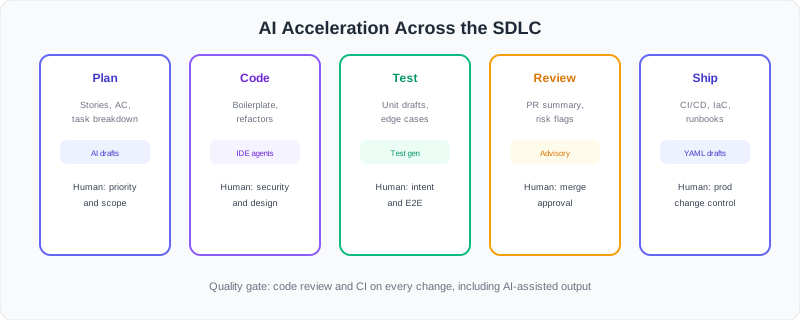
1. Discovery and planning
What AI helps with:
- Drafting user stories and acceptance criteria from workshop notes
- Breaking epics into tasks with dependency hints
- Summarising legacy code or prior incidents for new team members
What still needs humans: Priority, scope cuts, and trade-offs with stakeholders — AI suggests; product and engineering lead decide.
Typical tools: ChatGPT, Claude, Notion AI, Jira/Linear AI features.
2. Coding and refactoring
What AI helps with:
- Boilerplate, adapters, DTOs, API clients, repetitive CRUD
- Refactors scoped to a module ("extract service", "add error handling")
- Explaining unfamiliar code paths before a change
What still needs humans: System boundaries, security-sensitive logic, concurrency, and anything that touches money, identity, or compliance without tests.
Typical tools: GitHub Copilot, Cursor, Codeium, JetBrains AI Assistant.
3. Testing and QA
What AI helps with:
- Unit test skeletons from function signatures and examples
- Edge-case suggestions from branch analysis
- Test data generation and fixture scaffolding
What still needs humans: Integration and E2E strategy, performance tests, and acceptance tests tied to business rules. Generated tests can assert the wrong behaviour confidently.
Typical tools: CodiumAI, built-in IDE test generation, CI-integrated LLM helpers.
4. Code review and documentation
What AI helps with:
- PR summaries, risk flags ("missing null check", "SQL injection pattern")
- Docstrings, README updates, ADR drafts from diff context
What still needs humans: Approve merge. AI review is advisory — not a substitute for owner accountability.
Typical tools: GitHub Copilot for PRs, Sourcegraph Cody, custom review bots on GitLab/GitHub.
5. DevOps, infrastructure, and operations
What AI helps with:
- Drafting Dockerfile, Helm, Terraform, and pipeline YAML from templates
- Parsing log snippets and suggesting runbook steps
- Alert rule drafts and dashboard queries
What still needs humans: Production change control, secrets, blast radius, and rollback drills. Never auto-apply infra changes without review.
Typical tools: Chat-based assistants, vendor copilots in Azure/AWS consoles, internal platform bots.
AI-Driven vs Traditional Delivery
| Aspect | Traditional | AI-driven (with governance) |
|---|---|---|
| First draft of code | Manual | AI-assisted; human edits |
| Test creation | Manual first; auto later | AI drafts; human validates intent |
| Legacy exploration | Read code + ask seniors | AI summarises; senior confirms |
| Documentation | Often lagging | Generated from diffs; reviewed |
| Onboarding | Weeks to first PR | Days to first PR — domain still takes months |
| Quality gate | Review + CI | Same — AI does not remove gates |
| Risk profile | Known | Higher volume of subtle wrong code if review slips |
The last row matters: AI-driven development increases throughput of changes — which magnifies the cost of weak review or missing tests.
Governance: What Enterprise Teams Implement in 2026
Ad hoc tool usage becomes a policy problem quickly. Mature teams define:
Data and IP
- Which repos and prompts may leave the corporate boundary
- Ban on pasting secrets, PII, and unreleased financial data into public models
- Preference for enterprise tiers with no training on customer code where available
Approved tooling
- Allow-list of IDEs, extensions, and model providers
- Version pinning for internal coding agents
Human-in-the-loop rules
- AI-generated code in production paths requires normal PR review
- Security-sensitive modules ( auth, crypto, payments ) — AI assist allowed; human author accountable
Measurement
- Track lead time, defect escape rate, and review time — not "lines AI wrote"
For product-level AI ( agents, automation ), governance overlaps with build-vs-buy decisions for product AI and often fintech-style controls when data is sensitive.
Measuring Impact Without Vanity Metrics
Useful indicators:
| Metric | What it tells you |
|---|---|
| Lead time for change | End-to-end speed including review |
| PR size and review time | AI often increases PR count — watch reviewer load |
| Defect escape rate | Post-release bugs; should not rise after AI adoption |
| Test coverage ( meaningful ) | New tests that assert behaviour, not only lines |
| Senior time on design | Interviews and calendars — less boilerplate, more architecture |
Avoid celebrating lines generated. Celebrate shipped outcomes with stable quality.
Where AI Does Not Accelerate Delivery (Yet)
Being explicit prevents disappointment:
- Greenfield architecture — context, constraints, and org politics dominate; AI drafts help documents, not decisions
- Deep legacy migrations — AI helps read code; sequencing and risk live with architects ( see application modernization )
- Novel regulated logic — payments, healthcare, crypto compliance — requires validated specs and audits
- Team coordination — dependencies across squads, vendor contracts, and engagement model issues are not solved by Copilot
AI amplifies an existing delivery system. Weak process + AI = faster chaos.
Organising Teams for AI-Driven Delivery
Patterns that work in 2026:
Platform guardrails first — templates, linters, CI, and secure defaults before rolling out coding agents org-wide.
Pair AI with strong review culture — especially on dedicated teams where velocity targets are high.
Separate "process AI" from "product AI" — different skills, different roadmaps; our AI development services cover product features, while delivery acceleration is an engineering practice layer.
Upskill on prompting and verification — juniors ship faster with AI; seniors focus on verification, integration, and system design.
For full-stack product delivery with AI both in the toolchain and in the product, teams often combine web and mobile engineering with AI automation solutions.
Practical Checklist Before You Scale AI-Driven Development
| Step | Action |
|---|---|
| 1 | Document allowed tools and data rules |
| 2 | Ensure CI runs tests on every AI-assisted PR |
| 3 | Train reviewers on common AI failure modes ( plausible wrong code, outdated APIs ) |
| 4 | Pilot one squad; measure lead time and defect rate for one quarter |
| 5 | Expand with platform templates, not blanket licenses |
Conclusion
AI-driven development accelerates software delivery when AI is embedded across planning, coding, testing, review, and ops — and when governance, review, and metrics stay central. The win is not typing speed alone; it is shorter feedback loops with stable quality.
Teams that treat AI as a co-pilot under human accountability ship faster without trading away security or maintainability. Teams that skip review to "move fast" pay later in incidents and rework.
Smartym Pro builds AI-powered products and high-performance engineering teams that use modern AI tooling under clear delivery discipline — from custom agents to enterprise web and integration platforms.
Want to accelerate delivery with AI — in your toolchain or in your product? Tell us about your goals — we will help you scope governance, team shape, and a realistic first release.