
Custom Software Development vs Off-the-Shelf: When Bespoke Wins for Enterprise
Compare custom software development with off-the-shelf products — when bespoke software wins for enterprise, and when packaged SaaS is the smarter choice.
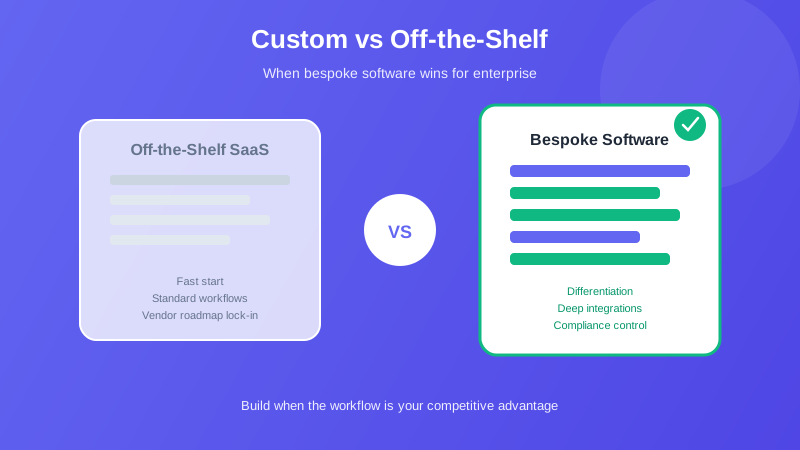
Enterprise teams rarely start a procurement conversation with a blank slate. The default path is familiar: evaluate a shortlist of SaaS vendors, run a pilot, sign an annual contract, and adapt internal processes to the product. Custom software development enters the picture when that path stops working — when competitive differentiation, regulatory constraints, or integration complexity make a packaged product more expensive than it looks on a pricing page.
This article compares custom software development with off-the-shelf solutions from an enterprise buyer's perspective. The goal is not to declare one approach universally better, but to clarify when bespoke software development delivers measurable advantage — and when a well-chosen SaaS product is the rational choice.
Introduction: Two Different Buying Problems
Off-the-shelf software solves a category problem: payroll, CRM, project management, identity management. Mature vendors have invested years in edge cases, compliance certifications, and ecosystem integrations. For many departments, buying beats building.
Custom software development solves a business-specific problem: workflows that define how you compete, systems that connect proprietary data across legacy platforms, or products you sell to your own customers. Here, "good enough" SaaS often means operational compromise spread across hundreds of users for years.
The mistake we see repeatedly is applying SaaS evaluation criteria to a build decision — or vice versa. Speed-to-pilot favors SaaS; long-term total cost of ownership and strategic fit favor bespoke when the use case is core to the business.
When Off-the-Shelf Wins
Packaged software is the right default when several conditions align.
Standard processes with limited differentiation
If the workflow matches how most companies in your industry operate — expense approval, basic ticketing, standard HR onboarding — a SaaS product will implement it faster and cheaper than a custom build. Vendors amortize development across thousands of customers; you benefit from that scale.
Time-to-value under tight deadlines
A departmental tool needed in weeks, not quarters, is a SaaS candidate. Configuration, training, and rollout can happen on vendor timelines. Custom software development, even with an experienced partner, requires discovery, architecture decisions, and iterative delivery.
Vendor ecosystem and compliance already built in
Established categories often include SOC 2 reports, GDPR tooling, SSO, and audit logs out of the box. Rebuilding those capabilities in a greenfield custom application is expensive unless they are truly insufficient for your regulatory context.
Predictable scope with low integration load
If the tool sits largely isolated from core systems — a standalone survey platform, a niche analytics dashboard fed by CSV exports — integration tax stays low and SaaS TCO remains attractive.
When Custom Software Development Wins for Enterprise
Bespoke investment pays off when the software is the business capability, not a wrapper around it.
Competitive workflows and proprietary logic
Retailers with unique allocation models, logistics operators with custom routing constraints, B2B platforms with pricing engines tied to contract data — these are not configuration problems. They are custom enterprise application development problems. Off-the-shelf products force the business to bend; bespoke software bends to the business.
Deep integration with legacy and data estates
Enterprise environments rarely offer a clean API layer. Custom software development lets you design integration boundaries deliberately: event-driven sync with ERP, gradual strangler patterns around a monolith, or a unified data model across acquisitions. SaaS middleware and iPaaS connectors help, but they break under volume, latency, or non-standard legacy interfaces.
Security, compliance, and data residency beyond vendor defaults
Regulated industries often need controls that SaaS vendors cannot contractually guarantee: specific encryption key custody, air-gapped segments, custom audit trails, or deployment in a jurisdiction the vendor does not support. Secure enterprise software built to your compliance team's checklist avoids negotiating exceptions with a vendor whose roadmap you do not control.
Product revenue or customer-facing differentiation
When software is sold or exposed to your customers — a client portal, a marketplace, an industry-specific platform — UX, performance, and feature velocity become revenue drivers. A custom software development company aligned to your product roadmap delivers capabilities on your schedule, not a vendor's quarterly release train.
Total cost of ownership at scale
SaaS pricing that looks cheap at 50 seats can become punitive at 5,000 — especially with per-transaction fees, API call limits, or mandatory platform tiers. Model five-year TCO including integration staff, workaround processes, and renewal uplifts. Custom development has higher upfront cost but flattens marginal cost as usage grows.
Decision Framework: Questions to Ask Before You Choose
Use this checklist in steering committee or architecture review.
| Question | Lean SaaS | Lean custom |
|---|---|---|
| Does this workflow differentiate us in the market? | No | Yes |
| Will we need deep real-time integration with core systems? | Rare / batch OK | Yes |
| Are regulatory requirements non-standard for our sector? | Standard category | Yes |
| Is this a revenue product or cost-center tool? | Cost center | Revenue / strategic |
| Will user count or transaction volume grow 10× in 3 years? | Stable | High growth |
| Can we accept vendor roadmap dependency for key features? | Yes | No |
If most answers point right, start a bespoke software development discovery with a partner who understands enterprise delivery — not a body shop quoting lines of code.
Hybrid Approaches That Work in Practice
Pure build-or-buy is rare. Successful enterprises combine both.
Buy the commodity, build the core. Use SaaS for email, identity, and horizontal tools; invest custom development in the systems that encode competitive advantage.
Custom wrapper, packaged engine. Some teams build a custom experience layer while using licensed components for payments, document generation, or ML APIs — reducing build scope without surrendering UX control.
Build first, evaluate SaaS later. Greenfield products sometimes ship as custom MVPs to validate market fit, then selectively replace subsystems with packaged services once requirements stabilize. The reverse — SaaS first, expensive custom escape — is usually costlier.
Our web application development services cover both greenfield bespoke products and modular extensions to existing estates — the engagement model depends on where you sit on this spectrum.
What Enterprise Buyers Should Expect from Custom Development
Choosing custom software development commits you to a partnership, not a SKU. Realistic expectations:
Discovery before estimates. Credible vendors invest in requirements workshops, risk registers, and phased roadmaps before fixed-price commitments on complex scope.
Incremental delivery. Enterprise programs succeed with working software every few weeks — not a big-bang release eighteen months out.
Transparent governance. You should see backlog priority, velocity, quality metrics, and escalation paths — whether the team is nearshore, offshore, or blended.
Evolution, not abandonment. Production software needs monitoring, security patches, and feature iteration. Budget for end-to-end software development through launch and into operation.
Smartym Pro delivers enterprise software development for B2B clients across EU and global markets — from web platforms and integrations to long-running product engineering. Explore our services hub for the full practice map.
Common Pitfalls When Comparing Options
Pilot success ≠ enterprise fit. A SaaS pilot with 20 friendly users hides permission-model gaps, performance limits, and integration failures that appear at rollout.
Underestimating integration tax. "They have an API" does not mean your ERP, data warehouse, and identity provider connect cleanly. Integration often consumes 30–50% of program effort.
Confusing configuration with custom development. Heavy SaaS customization — custom objects, Apex, proprietary scripting — creates vendor lock-in without the ownership benefits of true bespoke code.
Ignoring exit cost. Custom software you own can be maintained or migrated. SaaS data export, contract termination, and process re-engineering are recurring risks at renewal time.
Conclusion
Off-the-shelf software remains the efficient choice for standard, departmental, and fast-deployment needs. Custom software development wins for enterprise when differentiation, integration depth, compliance, and scale economics favor ownership over subscription.
The decision is strategic, not technical alone. Map your use case to the framework above, model multi-year TCO honestly, and involve engineering leadership early — before procurement locks a path that engineering will spend years working around.
If you are evaluating a bespoke build for a core business system, tell us about your project — we will help you scope the first phase and compare it realistically against packaged alternatives.