
Dedicated Development Team vs Project-Based Outsourcing: Which Model Fits When
Compare a dedicated development team with project-based outsourcing — ownership, pricing, change control, and when each model fits a long-term product vs a bounded deliverable.
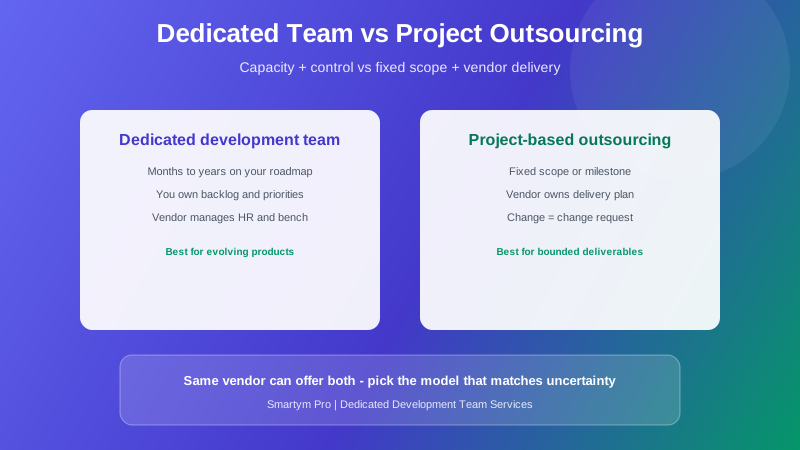
Engineering leaders evaluating external partners usually face the same fork early: buy capacity embedded in your process, or buy a defined outcome delivered by the vendor under a project contract. Both appear in RFPs as “outsourcing,” but they behave differently in backlog management, pricing, and who carries delivery risk.
A dedicated development team gives you senior engineers ( and often QA or DevOps ) who work primarily on your product for months or years — inside your rituals, with the vendor handling HR, bench, and team continuity. Project-based outsourcing assigns a vendor to deliver a scoped release, migration slice, or MVP against milestones — with the vendor owning the delivery plan for that scope.
This article compares the two models so you can align contract shape with how uncertain your roadmap is — and link the choice to the dedicated development team services Smartym Pro offers alongside fixed-scope delivery.
Two Different Buying Problems
| Question | Dedicated development team | Project-based outsourcing |
|---|---|---|
| What you purchase | Predictable engineering capacity | A bounded deliverable or phase |
| Who owns the backlog | You ( product / engineering leadership ) | Shared — vendor plans within SOW |
| Typical horizon | Quarters to years | Weeks to months per phase |
| Pricing shape | Monthly team fee / rate card | Fixed price, milestone, or capped T&M |
| Change handling | Reprioritize sprint to sprint | Change requests and re-estimation |
| Best signal of success | Throughput, quality, retention | Milestone acceptance, go-live date |
Neither model is universally better. The wrong choice shows up as friction: a fixed-price vendor asked to absorb endless scope drift, or a dedicated team engaged without product ownership on your side.
For a wider comparison including time-and-materials and hybrids, see engagement models pros and cons.
What a Dedicated Development Team Is ( and Is Not )
At Smartym Pro, a dedicated development team means engineers who work primarily on your product, in your stand-ups, backlog, and code-review culture — for a long horizon. The vendor manages recruitment, replacement, performance, and administrative overhead; you own product direction and engineering standards.
A dedicated team is not:
- A substitute for in-house hiring when policy requires FTE badges on your payroll
- Automatically full outcome ownership by the vendor — unless contractually defined
- The same as commodity staff augmentation with no team stability or reporting
It is a strong fit when you need senior, vetted capacity quickly, prefer EU time-zone overlap, and want to steer the roadmap without building a large internal hiring pipeline first.
What Project-Based Outsourcing Is
Project-based outsourcing ( often fixed-price or milestone-based ) assigns the vendor to deliver a defined scope: an MVP, integration phase, migration wave, or audit remediation package. The vendor proposes a plan, staffs accordingly, and is accountable for delivery of that scope within agreed dates and acceptance criteria.
Project outsourcing works well when:
- Requirements are stable enough to specify in a statement of work
- You want price predictability for a phase with executive sign-off
- Internal product leadership is limited and you need the vendor to drive execution for that slice
- The work is bounded — a launch, a pilot, a compliance-driven release
It works poorly when the backlog changes weekly and success is measured by learning speed rather than a frozen feature list — unless you budget formal change control.
Side-by-Side: Governance and Risk
Ownership and embedding
Dedicated team: Engineers join your Slack, Jira, GitHub, and on-call rotations ( as you define ). Knowledge accumulates in your repos. Turnover is managed by the vendor without re-running your entire hiring process.
Project outsourcing: Embedding varies. Some vendors work in your tools; others use a separate delivery environment until handover. Knowledge transfer must be explicit in the SOW — especially for custom web platforms and integrations.
Scope and change
Dedicated team: Scope changes through your prioritization. Capacity is fixed; you choose what not to build this sprint.
Project outsourcing: Scope is contractual. New requests trigger impact analysis, CR pricing, or phase two. That discipline can protect budget — or slow learning if the process is heavy.
Pricing and cash flow
Dedicated team: Predictable monthly burn tied to team composition. Easier for multi-year capacity planning; harder to cap total spend without scope discipline on your side.
Project outsourcing: Lump sum or milestone payments align with deliverables. Risk shifts to the vendor for estimation error — often reflected in contingency markup.
Quality and accountability
Dedicated team: Quality is measured over sustained velocity, defect rates, and release stability — like an internal team.
Project outsourcing: Quality is tied to acceptance tests and demo milestones. Define non-functional requirements ( performance, security, accessibility ) in the SOW, not only feature checklists.
When to Choose a Dedicated Development Team
Choose a dedicated software development team when several conditions align:
- Multi-quarter roadmap — the product evolves faster than you can rewrite SOWs
- You have ( or will hire ) product and engineering leadership — someone owns backlog and architecture sign-off
- Domain knowledge compounds — fintech rules, legacy integrations, or enterprise Java backends where ramp-up is costly
- Steady release cadence — you ship every sprint or every few weeks, not one big bang
- Scale without local headcount — you need flexibility to grow or shrink the unit without layoffs on your books
Typical Smartym Pro clients use dedicated teams for long-running B2B products, platform extensions, and sustained modernization after an initial scoped phase.
When to Choose Project-Based Outsourcing
Choose project-based outsourcing when:
- Scope is definable — wireframes, API specs, or migration inventory exist
- Executive need for fixed budget — board or procurement requires a capped number
- One-off or pilot — validate a market before committing to permanent capacity
- Vendor-led discovery + build — you want a partner to own delivery for a single phase, then hand over
- Clear acceptance criteria — UAT scripts, performance thresholds, security scan gates
Many custom software development programs start as a fixed-scope MVP, then transition to a dedicated team once product-market fit and internal ownership mature.
The Hybrid Path ( Often the Best One )
Real programs rarely stay pure. A practical sequence:
- Short T&M or fixed discovery — validate architecture, estimates, and collaboration fit
- Fixed-price MVP or migration wave — bounded risk for the first release
- Dedicated development team — scale the same codebase with embedded engineers who already know the domain
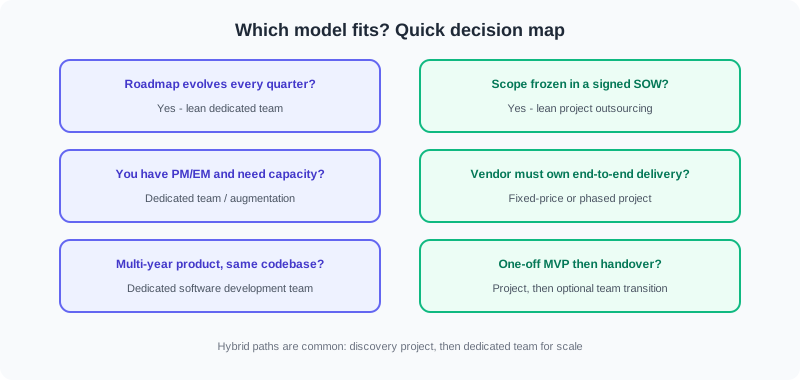
This hybrid appears in our engagement models guidance and on the dedicated development team service page — flexibility to adapt team shape ( full functional, pod, role augmentation ) as ownership on your side grows.
Common Mistakes
Using fixed-price for a research product. Discovery-heavy work needs time-and-materials or a capped discovery phase — not a feature list pretending certainty.
Using a dedicated team without internal prioritization. Embedded engineers idle or thrash when no one owns the backlog.
Confusing “dedicated” with “vendor owns outcomes.” Capacity models still need your product decisions unless you explicitly buy managed delivery.
Skipping IP and access terms. Same for both models — repos, environments, and handover artifacts belong in the contract from day one.
Ignoring time zones. For EU and UK clients, nearshore overlap matters in both models; daily collaboration fails with zero shared hours regardless of contract type.
How Smartym Pro Supports Both Models
Smartym Pro delivers dedicated development team services — senior engineers in Eastern Europe with overlap for Western European and US East Coast clients — and project-based phases when scope and milestones are clear.
We offer:
- Role-based augmentation and full functional teams under long-term dedicated engagements
- Fixed-scope phases for MVPs, integrations, and modernization slices
- Transparent reporting — velocity, quality signals, and team health for dedicated units; milestone and RAID tracking for projects
If you are deciding between models, we help map roadmap uncertainty, internal leadership, and budget shape — then propose a path that may start project-based and transition to a dedicated team without rewriting the entire codebase.
Conclusion
Dedicated development team vs project-based outsourcing is not a brand choice — it is a fit for uncertainty. Buy a dedicated team when you need embedded capacity on an evolving product you steer. Buy project outsourcing when scope, acceptance, and budget can be defined up front.
Many successful clients combine both: prove collaboration on a bounded phase, then scale with a dedicated software development team on the same stack and rituals.
Explore dedicated development team services →
Not sure which model fits your roadmap? Tell us about your product and constraints — we will help you choose between a dedicated team, a fixed-scope phase, or a hybrid path.