
Dedicated Team Engagement Models Explained: Full Functional, Pods, Role Augmentation, and When Each Fits
Dedicated development team engagement models — full functional, engineering pods, squads, role augmentation, tech extension, and hybrid — vs project outsourcing and in-house hiring.
Buying engineering capacity is rarely as simple as “we need more developers.” The same label — dedicated development team, team extension, IT staff augmentation — can describe different vendor responsibility, different client management load, and different expectations about delivery.
Misalignment is expensive. A CTO expecting outcome ownership under a fixed-price contract while the partner is staffed for augmentation will see “slow delivery.” Procurement treating a long-term dedicated software development team like commodity body leasing gets turnover and opaque reporting instead of partnership.
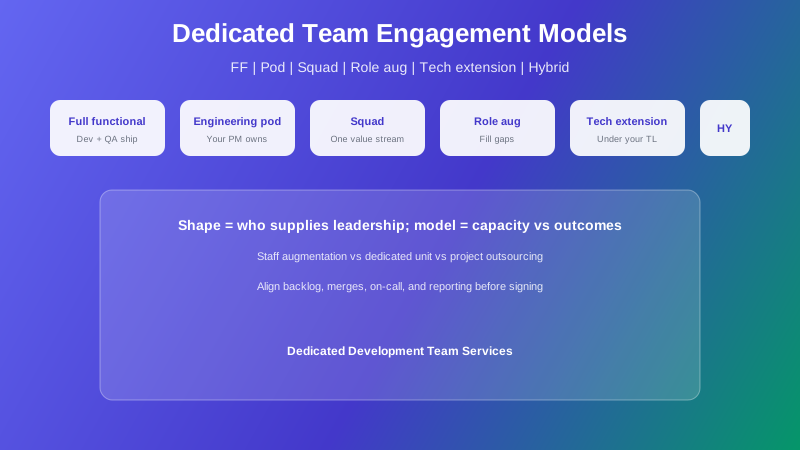
This article maps engagement models and team shapes Smartym Pro uses with clients: how composition ( full functional, pod, squad, role-based, tech extension, hybrid ) fits alongside commercial model ( augmentation vs project vs hire ). It complements dedicated team vs project outsourcing and the broader engagement models guide.
What a Dedicated Development Team Actually Means
A dedicated development team means engineers ( and optionally QA, DevOps, or delivery roles ) who work primarily on your product, inside your rituals — stand-ups, backlog, code review, release cadence — for a long horizon ( months to years ).
| Model | What you buy | Who runs day-to-day engineering |
|---|---|---|
| Dedicated team / team extension | Predictable capacity embedded in your process | You own product and engineering decisions; vendor manages HR, bench, performance |
| Fixed-price / outcome project | A defined scope or milestone | Vendor owns delivery plan for that scope |
| Custom software delivery | Product or system built to spec | Often vendor-led phases with client steering |
| In-house hire ( recruiting ) | FTE on your payroll | You own employment and all management |
A dedicated team is not a substitute for recruiting when policy requires employees on your payroll. It is strong when you need senior capacity quickly, want EU time-zone overlap, and prefer to steer the roadmap yourself — a pattern we cover in nearshore partner selection.
Staff Augmentation vs Dedicated Team
These terms overlap in marketing but imply different vendor responsibility.
Staff augmentation emphasizes roles: you need two senior backend engineers for nine months; you assign work. The vendor supplies people; you provide management depth.
Dedicated team emphasizes a unit: the vendor assembles a stable group, handles replacement and HR, reports on team health and throughput — while you still own the product. The relationship is closer to partnership than renting names from a list.
Write down before signing:
- Who owns the backlog and prioritization?
- Who approves merges to production?
- Who is on-call for incidents?
- Is success measured by velocity or shipped outcomes?
If those answers are unclear, fix the contract before debating hourly rates.
Team Shapes: Six Formats We Use With Clients
Once you choose augmentation-style engagement, the next question is composition — the framework we use when scoping dedicated development team services.
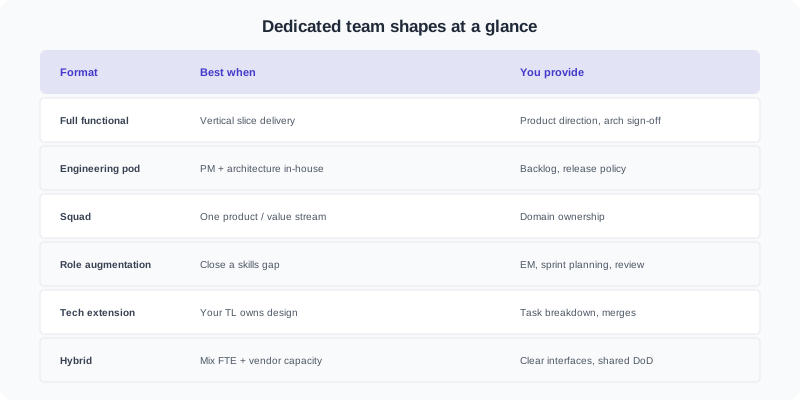
| Format | Best when | Typical composition | Client usually provides |
|---|---|---|---|
| Full functional team | You need a vertical slice of delivery ( build + test + ship ) | Devs + QA; optional DevOps, BA, SM, or tech lead from vendor | Product direction, architecture sign-off, repo access |
| Engineering pod | You have PM/PO and architecture; need execution and quality | Devs + QA; part-time DevOps if needed | Backlog, standards, release policy |
| Squad / feature team | Work aligns to one product or value stream | Like full functional, bound to one backlog and flow metrics | Domain ownership, stakeholder access |
| Role-based augmentation | You need to fill a gap in an existing roster | One or more similar roles ( e.g. only QA, only mobile ) | Engineering manager, sprint planning, code review |
| Tech extension under your tech lead | Your TL owns design; you need stack capacity | Senior/mid devs, sometimes + QA | Technical direction, task breakdown |
| Hybrid | Mix of your FTEs and vendor capacity | e.g. your mobile + our backend and QA | Clear interface between teams |
Full functional team — not “your entire IT”
Full functional delivers features through dev and QA without queueing each role separately. It does not replace your CIO, security office, or enterprise architecture board.
Many clients keep architecture in-house and use a full functional vendor team for implementation throughput.
Engineering pod vs squad
Both combine development and testing. The difference is scope of allegiance:
- A pod often serves a phase or workstream ( e.g. payments refactor Q3 ) with your PM in charge.
- A squad is usually long-lived, measured on flow for one product.
Start with a pod on a bounded initiative; expand to squad or full functional once working agreements are proven.
Role-based augmentation and tech extension
Role-based augmentation works when you have strong engineering leadership and need, for example, dedicated Java developers for enterprise workloads or extra QA before a release.
Tech extension works when your tech lead assigns tasks and reviews all merges; the vendor does not supply a parallel management layer.
Both require your management bandwidth. Without an EM or tech lead, a pod or full functional shape is usually safer.
Hybrid teams
Hybrids are common: in-house mobile, vendor backend and QA, shared design system. Success depends on interfaces — shared backlog or strict API contracts, joint retros, one Definition of Done for releases.
How This Differs From Project Outsourcing and Custom Delivery
Project-based outsourcing sells a result or phase ( migrate module X, MVP by date Y ). Governance centers on milestones and change control, not open-ended backlog pull. See our dedicated article on dedicated team vs project outsourcing.
Custom software development ( web application development and broader custom work ) often blends discovery, delivery, and handover — useful when the problem is not fully specified.
| If your primary need is… | Lean toward… |
|---|---|
| Ongoing roadmap, you own priorities | Dedicated team ( pod, squad, or full functional ) |
| Defined scope, vendor owns plan | Project / fixed scope |
| Greenfield product, heavy discovery | Custom delivery partnership |
| Permanent headcount in your entity | Recruiting / FTE, not augmentation |
Many clients start with a project, then transition into a dedicated software development team for maintenance and evolution.
IT Recruiting vs Dedicated Team
IT recruiting ( when you employ directly ) closes roles on your payroll — you run performance reviews and long-term career paths.
A dedicated development team keeps engineers on the vendor side while they work as an extension of your process. You scale down without layoffs on your books; scale up without six-month hiring cycles.
Choose recruiting when the role must be internal for policy or culture. Choose a dedicated team when you need speed, flexibility, and senior vetted capacity without expanding headcount in every jurisdiction. Discuss hiring vs extension via contacts if you are weighing both paths.
What to Agree Before You Start
Regardless of format, align in writing:
- Backlog ownership — who writes and prioritizes stories?
- Merge and release authority — who can ship to production?
- On-call and incident response — vendor, client, or shared?
- Reporting — velocity, quality, risk; cadence and audience
- IP and security — repos, secrets, device policy, background checks
- Ramp and replacement — onboarding time, notice if someone leaves
Skipping this list is how “we thought you had a dedicated team” turns into “they behave like freelancers.”
Geography: Nearshore as a Modifier
Nearshore describes where the team sits ( time-zone overlap with Western Europe or the US ), not how it is composed. A nearshore partner can staff any shape above.
If location and collaboration are your main questions, read nearshore software development and choosing a partner.
European searches for hire remote development team Europe often mean overlap, English fluency, and stable long-term engagement — why dedicated team + nearshore is a common combination.
How Smartym Pro Scopes Engagements
We do not sell a single template team. Typical steps:
- Clarify commercial model — augmentation vs project vs hybrid transition
- Pick team shape — full functional, pod, role-based, squad, tech extension, or hybrid
- Match stack and domain — e.g. Java, mobile, AI where relevant
- Onboard into your tools — access, ceremonies, Definition of Done, first sprint goals
- Review after 4–8 weeks — adjust composition if leadership or QA depth was mis-scoped
We avoid commodity body leasing: engineers are vetted, named where possible before start, and managed with transparency on who works on your account.
Common Mistakes When Choosing a Format
Buying full functional without product ownership. No team shape succeeds without client-side prioritization.
Role-based augmentation without engineering management. Extra developers without integration create merge bottlenecks.
Expecting fixed-price outcomes on augmentation terms. Augmentation optimizes throughput under your direction; fixed price optimizes defined deliverables.
Treating dedicated team as recruiting. Need FTE badges and internal comp bands — recruit, do not augment.
Ignoring platform boundaries. Vendor DevOps plus central platform team requires explicit RACI so pipelines are not duplicated.
Conclusion
Dedicated development team is an umbrella for long-term embedded capacity — not one fixed org chart. The useful question is not “dedicated or not?” but which shape matches your leadership, backlog maturity, and risk tolerance — and whether you buy capacity or outcomes.
When those lines are clear, staff augmentation and dedicated team partnerships stop competing in slides and start working in production.
Explore dedicated development team services →
Weighing formats for an upcoming roadmap? Tell us about your context — we will recommend shape and stack without pushing a one-size-fits-all bench.