
Fintech Software Development: Regulatory and Security Checklist Before You Build
A practical checklist for fintech software development — regulatory scope, security controls, and engineering decisions to validate before you write production code.
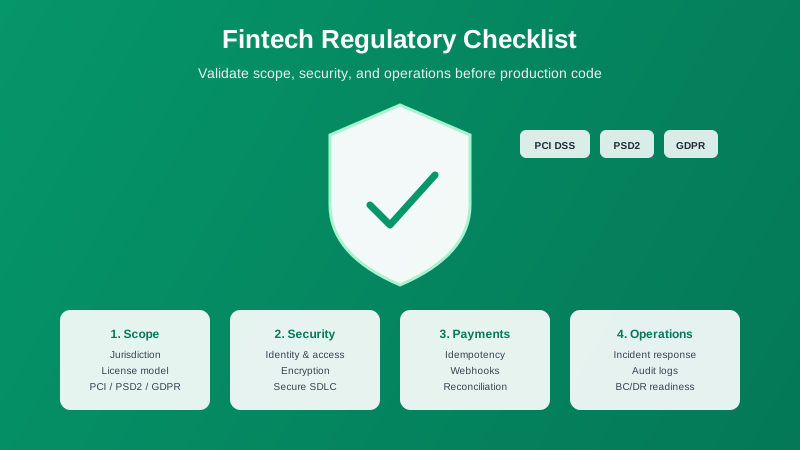
Fintech software development carries asymmetric risk: a defect in a marketing site is embarrassing; a defect in a payment flow is regulatory, financial, and reputational. Engineering teams often start coding while compliance scope is still a slide in someone else's deck — then discover mid-sprint that logging, key management, or consent storage was designed wrong.
This checklist is for CTOs, Heads of Payments, and engineering leads planning financial software development services or in-house builds. It is not legal advice; it translates common regulatory and security expectations into engineering decisions you should validate before production code — so your fintech software development company or internal team builds on firm ground.
Introduction: Regulated Context Changes Every Requirement
Consumer app checklists start with UX and uptime. Fintech software development starts with jurisdiction, license boundaries, and which frameworks apply — PCI DSS for card data, PSD2 and local open-banking rules in the EU and UK, GDPR for personal data, sector-specific rules for lending or e-money.
Treat compliance as a scope input, not a gate at the end. The cost of retrofitting audit trails, data minimization, or segmentation after architecture freeze is multiples of getting it right in discovery.
Phase 1: Regulatory and Product Scope
Complete this before technical design sign-off.
Jurisdiction and license model
| Item | Question |
|---|---|
| Markets | Which countries will users and money flows touch? |
| Entity | Who holds the license — you, a partner bank, or a BaaS provider? |
| Product type | Payments, lending, e-money, investment, crypto-adjacent — each shifts obligations |
| Data residency | Must PII or transaction records stay in specific regions? |
Document answers in a single regulatory scope memo referenced by architecture and vendor contracts.
Framework mapping
Identify which frameworks bind your stack, not the industry in general:
- PCI DSS — if cardholder data enters or passes through your environment (even briefly), determine SAQ level or full scope with a QSA
- PSD2 / open banking — for account information or payment initiation in applicable markets; consent, strong customer authentication, and TPP registration affect API design
- GDPR / UK GDPR — lawful basis, retention, DPIA for high-risk processing
- Sector rules — AML/KYC workflows, transaction monitoring, reporting hooks
Engage compliance early on PSD2 compliant software development requirements — engineering implements what policy defines; ambiguity here becomes rework.
Third-party and BaaS dependencies
Most fintech products rely on licensed partners: card processors, core banking APIs, identity verification, fraud scoring. Map:
- Which party is system of record for each data element
- Contractual SLAs and liability for outages
- Sub-processor notification and audit rights
Your fintech software development architecture should mirror these boundaries in service ownership and logging.
Phase 2: Security Architecture Checklist
Validate these controls in design review — not during penetration testing alone.
Identity and access
- Role-based access with least privilege; break-glass procedures documented
- MFA for administrative and high-privilege operations
- Service-to-service authentication (mTLS, signed tokens) — no long-lived shared secrets in repos
- Session and token lifetimes aligned with SCA requirements where applicable
Data protection
- Encryption in transit (TLS 1.2+) and at rest for sensitive stores
- Key management: HSM or cloud KMS with rotation policy; developers never hold production keys
- Field-level encryption for especially sensitive attributes when required
- Data minimization — collect and retain only what product and law require
Network and environment segmentation
- Separate production from non-production; no production data in dev without masking
- Segment cardholder data environment (CDE) if PCI scope applies — narrowest possible scope
- WAF, rate limiting, and DDoS protection on public endpoints
Secure SDLC
- Threat modeling for payment and account flows before implementation
- Dependency scanning and patch SLAs for critical CVEs
- Code review gates for auth, crypto, and money movement paths
- Secrets in vaults; pre-commit hooks blocking credential leaks
Logging, monitoring, and audit
- Immutable or append-only audit logs for privileged actions and financial events
- Correlation IDs across services for incident investigation
- Alerting on anomaly patterns — velocity limits, geo anomalies, auth failures
- Retention periods meeting legal and PCI log requirements (often distinct from application debug logs)
Banking software development and payment software development both fail in production when observability is an afterthought. Design dashboards and runbooks with the same priority as feature stories.
Phase 3: Payment and Open Banking Engineering
If your product moves money or accesses account data, add these engineering checks.
Idempotency and reconciliation
- Idempotency keys on all payment and transfer APIs
- Daily reconciliation between internal ledger, processor reports, and bank statements
- Explicit handling of async states — authorized, captured, failed, disputed
Webhooks and partner APIs
- Signature verification on inbound webhooks
- Retry-safe processing with deduplication stores
- Timeout and circuit-breaker policies on outbound banking calls
Consent and credential lifecycle (open banking)
- Store consent records with expiry, scope, and revocation handling
- Token refresh and re-authentication flows tested against bank sandbox variance
- User-facing consent UX meeting regulatory clarity — engineering implements, legal validates
Our open banking API integration case shows how these patterns apply in a real multi-bank environment — useful reference when scoping similar open banking integration work.
Fraud and abuse
- Rate limits, device fingerprinting hooks, or integration with fraud vendors as required
- Rules for blocking, reviewing, and releasing suspicious transactions with audit trail
Phase 4: Operational and Organizational Readiness
Technology alone does not satisfy regulators or auditors.
| Area | Minimum expectation |
|---|---|
| Incident response | Playbooks, roles, notification timelines |
| Change management | Traceable deployments; rollback tested |
| Vendor management | Due diligence on subprocessors |
| Business continuity | RPO/RTO for payment-critical paths |
| Privacy | DPIA, DSR process, breach notification workflow |
Fintech software development company proposals should address how they document decisions, hand over runbooks, and support audit evidence — not only sprint velocity.
Common Mistakes Before the First Production Release
Starting build before PCI scope is drawn. "We use a hosted iframe" does not automatically eliminate scope — understand your flows with a QSA.
Logging PAN or credentials. Structured logs accidentally capture request bodies; scrub at ingestion.
Treating sandboxes as production analogs. Bank and scheme sandboxes behave differently; plan hardening sprints after certification.
Underestimating reconciliation. Engineering completes "happy path" payments; finance discovers unmatched settlements weeks later.
Silencing compliance late. Invite compliance to architecture reviews; their red lines are cheaper early.
How Smartym Pro Approaches Fintech Builds
We deliver fintech software development and financial software development services for regulated and high-stakes contexts — payment orchestration, open banking adapters, and channel applications integrated with Java backend services. We work alongside your compliance and risk functions; we do not replace them.
Technical depth in Java backend and integration services complements product delivery when your stack is API-first and integration-heavy — a common pattern in payment software development and core-adjacent modernization.
Explore broader capabilities on our services hub, or review the open banking reference above for integration patterns.
Conclusion
Successful fintech software development begins with regulatory scope, security architecture, and operational readiness — encoded in checklists your team validates before scaling the backlog. PCI, PSD2, GDPR, and sector rules translate into concrete design choices: segmentation, logging, idempotency, consent storage, and reconciliation.
Use the phases in this article in steering committees and architecture reviews. Close gaps in discovery; do not borrow against production incidents.
Planning a regulated fintech build or modernization? Tell us about your project — we will help you align engineering scope with the compliance constraints that govern your market.