
How Custom AI Agents Can Help Optimize Your Business
Custom AI agents for enterprise workflows in 2026 — architecture, use cases, governance, and when to build vs buy off-the-shelf automation.
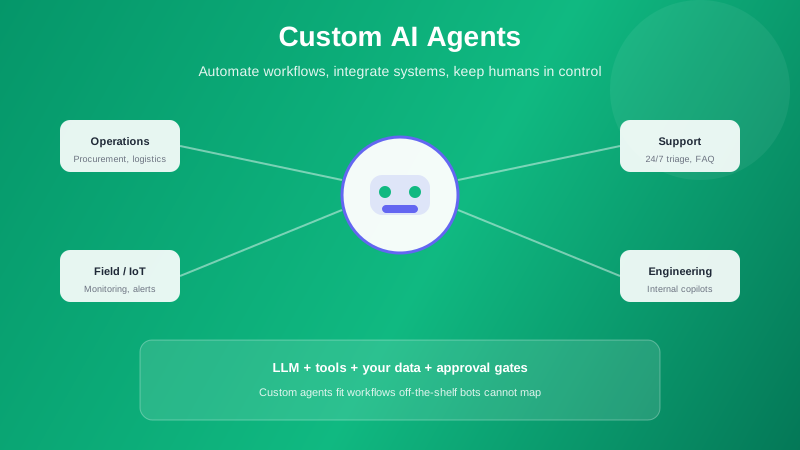
Enterprise adoption of AI agents moved from pilot chatbots to workflow automation — systems that plan steps, call internal APIs, retrieve company knowledge, and escalate to humans when risk or policy requires it. Surveys consistently show a large share of enterprises planning agent adoption within the next few years; the harder question is no longer whether but which workflows deserve a custom agent versus a packaged SaaS feature.
This article explains what custom AI agents are, how they differ from generic assistants and from AI in the development toolchain, where they deliver measurable business optimization, and how to scope a production-ready build in 2026.
What Is an AI Agent (and What It Is Not)
An AI agent is software that uses a language model ( and often other models ) to ** pursue a goal through multiple steps** — calling tools, reading documents, updating systems — rather than returning a single chat reply.
| Concept | What it does | Example |
|---|---|---|
| Chatbot | Answers questions from a fixed knowledge base | FAQ on a marketing site |
| Copilot | Assists a human in one session | IDE coding assistant |
| AI agent | Executes or orchestrates a workflow with tool access | Invoice validation, ticket triage, monitoring alerts |
| Multi-agent system | Several specialised agents hand off subtasks | Research agent + approval agent + ERP writer |
Not every automation needs an agent. If rules are fixed ( if amount > X then route to Y ), traditional workflow engines or RPA may be cheaper and easier to audit. Agents earn their place when steps require language, context, unstructured documents, or variable decision paths — with guardrails.
Prebuilt agents from cloud vendors ( HR, sales, support templates ) work for standard processes. Custom AI agents matter when your data, integrations, compliance rules, or industry logic do not fit a catalog product — see the Custom vs Off-the-Shelf Agents section below and our AI development services.
Typical Architecture of a Custom AI Agent
Production agents in 2026 usually combine:
- Orchestration layer — plans steps, manages memory, enforces policies
- LLM — hosted ( enterprise API ) or private deployment for sensitive data
- Tools — REST/GraphQL connectors to CRM, ERP, ticketing, email, internal microservices
- RAG ( retrieval ) — policies, contracts, manuals, past tickets in a vector store
- Human-in-the-loop — approval before irreversible actions ( payments, deletes, external email )
- Observability — logging prompts, tool calls, latency, cost, failure modes
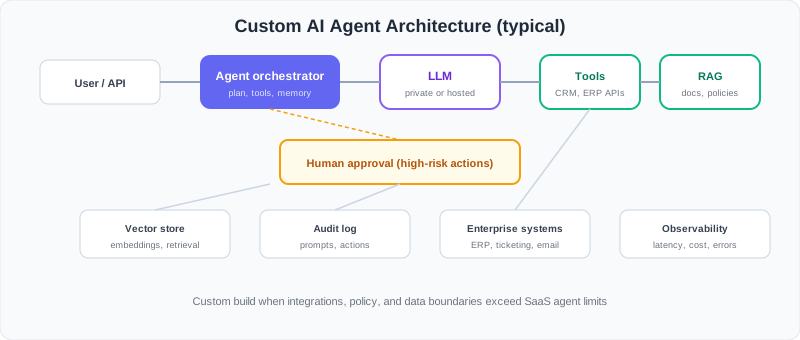
Custom development ensures agents respect your identity model, data residency, and audit requirements — not only your UI branding.
Where Custom Agents Optimize the Business
Operations and back office
Invoice and procurement processing — extract fields from PDFs, match POs and contracts, flag exceptions, route to approvers. Finance teams report significant cycle-time reduction when exception handling is automated but human sign-off remains on mismatches ( patterns aligned with fintech compliance thinking ).
Supplier and inventory workflows — monitor stock thresholds, draft replenishment requests, sync with ERP.
Customer and employee support
Tier-1 triage — classify intent, pull account context, draft replies from knowledge base, escalate complex cases with summary.
Internal HR / IT helpdesk — onboarding checklists, policy Q&A from handbook RAG, ticket creation in ServiceNow or Jira.
Agents run 24/7 for intake and classification; humans handle edge cases and relationship-sensitive issues.
Field, construction, and IoT
Site monitoring — analyse camera or drone feeds for safety violations, compare progress to schedule, alert supervisors. Smartym Pro has delivered blockchain-backed construction monitoring and related field systems; vision + agent workflows extend the same domain with real-time triage before data is anchored for audit.
Predictive maintenance alerts — correlate sensor readings with runbooks and create work orders.
Engineering and product (internal agents)
Internal copilots — search architecture docs, draft release notes, open PRs from templates. Overlap with AI-driven development but aimed at product and ops knowledge, not only code completion.
Benefits — Stated Realistically
| Benefit | Mechanism | Caveat |
|---|---|---|
| Productivity | Less manual copying between systems | Requires good integrations |
| Speed | Faster first response and routing | Not full autonomy on day one |
| Consistency | Same policy applied to similar cases | Policy must be encoded and tested |
| Scale | Handle volume spikes without linear hiring | Monitor cost per task |
| Decision support | Summaries and recommendations | Human accountable for regulated decisions |
Avoid treating vendor headline savings ( e.g. contact-center billions ) as guaranteed — outcomes depend on workflow choice, data quality, and rollout discipline.
Custom vs Off-the-Shelf Agents
| Factor | Off-the-shelf agent / SaaS | Custom AI agent |
|---|---|---|
| Time to first demo | Days | Weeks to first production slice |
| Integration depth | Standard connectors | Your ERP, legacy APIs, custom auth |
| Data boundaries | Vendor cloud | Your VPC, on-prem, or hybrid |
| Policy control | Template guardrails | Fine-grained approval rules |
| Differentiation | Low | High — workflow is yours |
Rule of thumb: start SaaS when the workflow is commodity; build custom when integration + compliance + domain logic is the product.
How to Build a Custom Agent (Delivery Phases)
- Define the workflow, not the model — one measurable outcome ( e.g. "reduce invoice exception handling from 2 days to 4 hours" )
- Map tools and data — which systems the agent may read vs write; no write access until trust is proven
- Design approval gates — list actions that always require human confirmation
- Build a thin vertical slice — one happy path end-to-end with logging
- Add RAG with curated corpora — policies and templates versioned like code
- Harden — rate limits, PII redaction, penetration test on tool endpoints
- Operate — monitor drift, cost, failure rates; retrain prompts and retrieval on incident review
Technology choices vary: Python services, LangGraph / similar orchestration, cloud AI services, vector DBs, and your existing web/mobile backends for UI and auth. The stack matters less than boundary design.
Governance and Risk (Non-Negotiable in 2026)
- Least privilege on tool credentials — agent service accounts, not user passwords
- Audit trail of prompts, retrieved documents, and tool invocations
- No training on customer data without contract clarity when using hosted models
- Fallback when model or tool fails — queue for human, do not silently skip
- Evaluation sets — regression tests on representative tasks before prompt changes ship
Agents that send external email, move money, or modify production config are high-risk — treat them like production microservices with review and rollback.
When Not to Build an Agent
Skip or defer agents when:
- Rules are fully deterministic — use workflow engine or RPA
- Data is too messy for retrieval — fix data first
- Legal requires fully explainable deterministic logic only
- The organisation lacks owner for workflow outcomes — agents amplify unclear ownership
How Smartym Pro Helps
We design and build custom AI agents and the surrounding platform — integrations, admin UI, approval flows, and observability — as part of our AI development services. Our background in custom software, enterprise integrations, and domain-heavy delivery ( construction, fintech-adjacent flows, blockchain audit trails ) informs how we scope agents that survive production, not demo day.
Typical engagement shapes:
- PoC — one workflow, limited tools, measured against baseline metrics
- Production agent — hardened auth, monitoring, handover to your ops team
- Agent + product — customer-facing copilot embedded in your SaaS
Pair agent work with the right engagement model — fixed slice for PoC, dedicated team for a multi-agent roadmap.
Use Case Snapshot (Patterns We See)
Construction monitoring — vision or sensor inputs, policy checks ( PPE, zone access ), supervisor alerts, optional ledger anchor for audit.
Financial procurement — document extraction, three-way match, exception queue for AP team — substantial cycle-time improvement when humans keep final approval.
Engineering enablement — internal agent over architecture docs and runbooks; deflects repetitive questions, links to AI-assisted delivery practices without replacing code review.
These patterns share structure: narrow scope, measurable KPI, human gate on irreversible actions.
Conclusion
Custom AI agents optimize business operations when they automate multi-step, language-aware workflows tied to your systems — with governance, integrations, and human oversight built in from the start. Generic chatbots and catalog agents cover commodity cases; custom builds win on data boundaries, policy, and domain fit.
Start with one workflow worth measuring, not an "AI strategy" slide. Prove value on a vertical slice, then expand tool access and domains deliberately.
Smartym Pro helps enterprises design, build, and operate custom AI agents that integrate with real backends — not isolated demos. Explore AI development services or tell us about your workflow — we will help you scope PoC, architecture, and a realistic path to production.
Ready to explore how custom AI agents can optimize your business? Contact Smartym Pro — we will discuss your workflows, integrations, and the fastest path to a measurable first release.