
Java Development Services for Enterprise: What Full Stack Means in 2026
What enterprise buyers should expect from Java development services in 2026 — full stack scope, Spring ecosystem, integrations, and how to evaluate a Java software development partner.
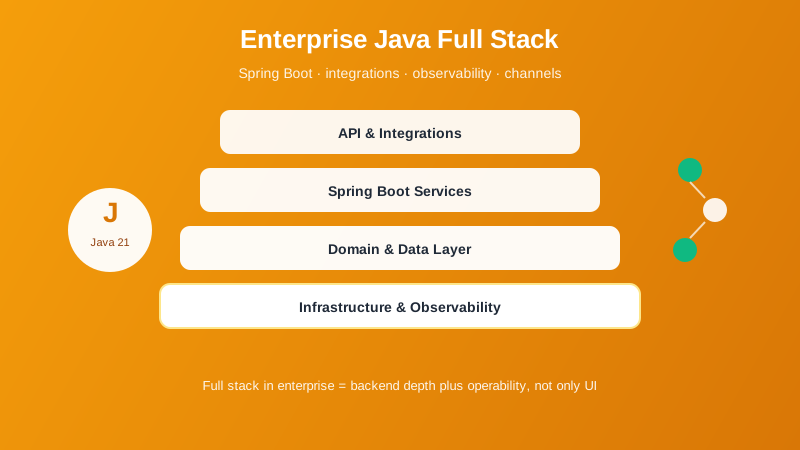
The phrase "full stack" appears on almost every Java development services proposal — and it means different things to different vendors. For enterprise buyers, ambiguity is expensive: you might hire a team strong on REST APIs but weak on data migration, observability, or the integration patterns your payment or open-banking flows require.
This article defines what enterprise Java development should cover in 2026, how the Spring ecosystem shapes delivery, and what to look for when you evaluate a Java software development company — whether you are building a new platform, evolving a monolith, or extending high-load backend services.
Introduction: Java Is Still the Enterprise Default
Despite periodic "Java is legacy" headlines, Java development services remain central to banks, logistics operators, telecoms, and B2B platforms that prioritize stability, tooling maturity, and deep talent pools. JDK 21 LTS, Spring Boot 3.x, and cloud-native deployment patterns keep the stack modern without sacrificing the decade of institutional knowledge embedded in existing codebases.
For procurement and engineering leaders, the question is not whether Java fits — it is whether your partner's definition of full stack matches the depth your program actually needs.
What "Full Stack" Means for Enterprise Java in 2026
In consumer web contexts, full stack often means React plus a Node API. In enterprise Java development, the stack is wider and skews backend-heavy.
Application and domain layer
Services encapsulating business rules, validation, and transactional boundaries — typically Spring Boot development with clear domain modules, DTO mapping, and test pyramids that include contract and integration tests, not only unit tests.
API and integration layer
REST and event-driven interfaces to internal systems, partners, and SaaS products. Java backend development for enterprise includes idempotent payment handlers, retry policies, outbox patterns, and schema versioning — especially when Kafka or message brokers sit between services.
Data and persistence
Relational stores (PostgreSQL, Oracle where legacy demands it), caching, read replicas, and migration discipline. Java microservices development adds explicit data ownership per service — a design choice that prevents the distributed monolith anti-pattern.
Infrastructure, security, and observability
Container orchestration, CI/CD pipelines, secrets management, structured logging, metrics, and distributed tracing. Full stack in 2026 assumes enterprise application development in Java ships with operability built in — not bolted on after launch.
Front-end and channel applications (when in scope)
Many Java development services engagements include web or mobile clients — either built by the same team or coordinated with dedicated UI specialists. The Java team's responsibility is still API quality, authentication flows, and performance under load.
If a vendor's "full stack" slide stops at CRUD and Swagger, you are looking at a partial team.
The Spring Ecosystem as Delivery Backbone
Spring Boot development is the de facto standard for greenfield enterprise Java development and for strangler-style extractions from legacy monoliths. In 2026, buyers should expect fluency in:
- Spring Boot 3 on JDK 17 or 21 with native compilation only where it solves a measured problem — not as a default complexity tax
- Spring Security integrated with corporate identity (OIDC, SAML) and service-to-service auth
- Spring Data with explicit transaction boundaries and performance testing on hot queries
- Modular boundaries — packages or modules that reflect domain contexts before jumping to microservices
Microservices are a deployment choice, not a moral imperative. A well-structured modular monolith often outperforms premature Java microservices development when team size and traffic do not justify operational overhead.
High-Load and Integration-Heavy Contexts
Enterprise Java programs frequently intersect payments, billing, and partner APIs. Java backend development in these domains requires:
Idempotency and exactly-once semantics — duplicate webhook delivery must not double-charge or duplicate ledger entries.
Saga or outbox orchestration — long-running business processes across services with compensating actions when a step fails.
Backpressure and queue tuning — Kafka consumer groups, DLQs, and replay strategies documented before production incidents.
Performance under JDBC and GC — profiling, connection pool sizing, and heap tuning for sustained throughput, not only peak demo loads.
Smartym Pro's Java and Oracle engineering practice covers service design, integration hardening, and evolution from monolith toward microservices where business boundaries support it.
How to Evaluate a Java Software Development Company
Use these signals beyond résumé keyword counts.
Seniority in production, not tutorials
Ask for examples of systems still running under load — migration stories, incident postmortems, and trade-offs they would make differently. Hire Java Spring Boot developers with demonstrated ownership of production outcomes, not only feature tickets.
Architecture literacy in discovery
Strong partners challenge requirements: they propose bounded contexts, identify integration risks early, and separate MVP scope from platform investments.
Quality and release engineering
Automated pipelines, environment promotion strategy, and definition of done that includes observability dashboards and rollback plans.
Alignment with your engagement model
Some programs need a dedicated development team embedded in your sprint cadence; others need a defined delivery phase with handover. The best Java software development company for you fits how you govern work — not only hourly rate.
Cross-practice depth for regulated domains
Fintech and open-banking programs often need Java integration expertise plus compliance-aware design. Our work on open banking API integration illustrates backend patterns — consent flows, token lifecycle, webhook reliability — that pure application teams may not have seen before.
Monolith Evolution vs Greenfield: Different Playbooks
Greenfield: prioritize clear API contracts, CI from day one, and restrained service count until domain boundaries prove stable.
Monolith evolution: map strangler routes, feature flags, and data sync strategies before splitting services. Enterprise Java development migrations fail when teams copy code into new repos without rethinking ownership and consistency.
Legacy JDK uplift: migrating to Java 17 or 21 is a program, not a dependency bump — framework upgrades, deprecated API removal, and performance validation belong in the same backlog.
For modernization programs that span Java uplift and cloud migration, see also our application modernization services — often paired with Java backend work.
What to Put in an RFP or SoW
Clarity reduces friction after vendor selection.
- Domain context and integration inventory (systems, protocols, SLAs)
- Non-functional requirements: RPS targets, RPO/RTO, compliance frameworks
- Expected team composition (architect, senior engineers, QA, DevOps)
- Definition of done per increment — including monitoring and documentation
- Knowledge transfer and code ownership expectations
Vague "Java development services" scopes produce vague outcomes. Anchor the statement of work to deliverables and measurable quality gates.
Conclusion
In 2026, Java development services for enterprise mean more than Spring CRUD and a UI. Full stack spans domain modeling, resilient integrations, data ownership, security, and operability — with front-end channels when the program demands them.
When evaluating partners, test for production depth, architecture rigor in discovery, and fit with your governance model. The right Java software development company reduces risk on the systems that run your business — not just ships stories.
Planning a Java backend program, monolith split, or integration-heavy platform? Get in touch — we will help you define scope and team shape for a realistic first release.