
Nearshore Software Development: How to Choose the Right Partner
Nearshore software development for European and US companies — CEE advantages, dedicated team engagement, and nine criteria to evaluate a nearshore partner.
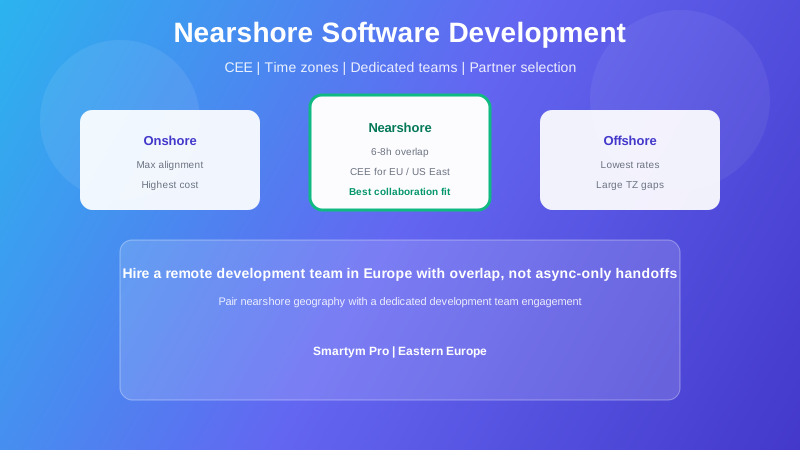
Companies looking to hire a remote development team in Europe rarely lack vendor options — they lack overlap: shared working hours, stable engineers, and an engagement structure that survives beyond the first sprint. Nearshore software development addresses that gap by placing engineers in geographically close regions with minimal time-zone friction, while still offering meaningful cost advantage versus purely onshore hiring.
At Smartym Pro, we operate as a nearshore development partner from Central and Eastern Europe ( CEE ) for clients across Western Europe and the United States. This article explains what nearshore means, how it compares to offshore and onshore models, why CEE is a strong region for European buyers, and how to evaluate partners — with emphasis on the dedicated development team model that makes nearshore collaboration work long term.
What Is Nearshore Software Development?
Nearshore development delegates software work to a team in a geographically close country — typically with cultural proximity and meaningful daily overlap in working hours.
Unlike traditional offshore outsourcing ( often 8–12 time zones away ), nearshore partnerships support live stand-ups, same-day escalation, and fast feedback loops. For product teams, that difference often matters more than marginal rate differences.
Nearshore describes where the team sits. How you engage them — dedicated unit, staff augmentation, or fixed-scope project — is a separate decision. See dedicated team vs project outsourcing for commercial model fit.
Nearshore vs Offshore vs Onshore
| Model | Collaboration | Cost vs onshore | Typical fit |
|---|---|---|---|
| Onshore | Maximum alignment, same time zone | Highest | Regulated, highly synchronous work with no external option |
| Offshore | Limited overlap; async-heavy | Lowest headline rates | Large batch work with tolerant latency |
| Nearshore | 4–8 hours shared window common | Moderate savings | Product engineering needing daily sync |
Onshore ( local team )
Advantages: Cultural alignment, straightforward management, no language barrier.
Disadvantages: Highest cost; scaling senior capacity can take quarters of recruiting.
Offshore ( distant region )
Advantages: Large talent pool; lower hourly rates on paper.
Disadvantages: Time-zone gaps erode real-time decisions; communication overhead often consumes savings.
Nearshore ( close foreign team )
Advantages: Daily overlap with Western Europe ( 0–2 hours ) or US East Coast ( ~6–8 hours ); strong engineering talent; 20–40% cost reduction vs onshore in many stacks.
Disadvantages: Fewer vendors than mega offshore markets — quality screening matters more.
Nearshore wins when communication speed and collaborative quality are business-critical — which describes most modern B2B and SaaS product teams.
Why Central and Eastern Europe for European Buyers
For companies that want to hire remote development team Europe resources with predictable quality, CEE plays the same nearshore role that Latin America plays for US West/East hybrid teams.
Why the region stands out:
- Time zone alignment — 0–2 hours with Western Europe; workable overlap with US East Coast
- Engineering heritage — strong STEM foundations; rigorous system design culture
- Cost structure — senior developer rates below Germany, UK, or Netherlands at comparable skill levels
- Business norms — direct communication, deadline orientation, result-focused delivery
- English proficiency — standard for technical professionals in client-facing roles
Smartym Pro teams work from this region under dedicated development team services — not rotating anonymous bench resources.
Nearshore Plus Dedicated Team: The Combination That Works
Geography alone does not guarantee success. The most effective long-term nearshore pattern is a dedicated software development team — engineers who work primarily on your product, integrate into your sprint cadence, and persist as a stable unit rather than a hourly resource pool.
This is the difference between partnership and body leasing: renting individuals with no continuity, no institutional knowledge, and accountability limited to billable hours.
A dedicated nearshore team typically means:
- The same engineers in your stand-ups month after month — they know the codebase and domain edge cases
- Vendor-managed HR — payroll, equipment, replacement, performance; you steer technical priorities
- Composable formats — from full functional delivery to role-based augmentation under your engineering manager
| Format | When it fits |
|---|---|
| Full functional team | Autonomous delivery of a product slice; you own product direction |
| Team extension | Existing tech lead; you need throughput on a known backlog |
| Engineering pod | You have PM and architecture; need implementation and QA |
| Role-based augmentation | Close a specific gap — Java backend, QA lead, mobile — under your management |
For format details, see dedicated team engagement models. For broader pricing and governance comparisons, see engagement models pros and cons.
Nine Criteria for Evaluating a Nearshore Partner
Partner selection drives a large share of outcome variance. Evaluate these dimensions before signing.
1. Technical depth
Request architectural examples and speak with engineers who will actually join — not only sales. Depth in your stack beats logo breadth.
2. Process maturity
Structured sprint planning, code review, requirements traceability, and technical debt handling. Ask how onboarding and scope changes work in practice.
3. Communication culture
Timeliness, transparency, and early bad-news escalation. Partners who hide problems until milestones slip are expensive.
4. Team stability and retention
High turnover destroys nearshore value. Ask average engineer tenure and how knowledge transfer works on rotation.
5. Scaling flexibility
Can the partner add senior capacity in weeks without destabilizing the existing team? Can you scale down smoothly when priorities shift?
6. Security and compliance
For fintech, health, and enterprise clients: ISO 27001, SOC 2 where relevant, data handling, NDAs, device policy — before access is granted.
7. Domain experience
Industry context reduces misunderstandings — especially in regulated fintech builds and complex integrations.
8. Cultural fit
Shared instincts on quality, deadlines, and dialogue matter as much as CV keywords.
9. Pricing transparency
Clear rate structure, no surprise line items, willingness to explain margin drivers honestly.
How Smartym Pro Approaches Nearshore Partnerships
We optimize for long-term partnerships, not one-off staff swaps.
Purpose-built teams. Every group is assembled for stack, product stage, and pace — not pulled from a generic bench.
Transparency. Clients know who works on what, how budget maps to composition, and where risks sit.
Engineering ownership. Developers contribute architectural input and proactive problem identification — not ticket-only execution.
Focused expertise. We work deeply in enterprise Java, web platforms, mobile, and AI development — rather than claiming every stack equally.
Common Mistakes When Selecting a Nearshore Partner
Choosing on rate alone. Low rates with high turnover and rework often exceed stable nearshore teams at market rates.
Ignoring cultural fit. Impressive portfolios with mismatched communication styles become chronic friction.
Skipping onboarding. Starting code without product and business context produces expensive rework.
Confusing engagement models. Expecting fixed-price outcomes from augmentation staffing — or vice versa — is a top source of disappointment. Align backlog ownership and merge authority before kickoff.
Underestimating management investment. Even embedded teams need regular sync and clear checkpoints.
Questions to Ask Before Signing
- Who specifically will work on our account? Can we meet them pre-start?
- How do you ensure continuity when someone leaves?
- How are requirement changes and scope creep handled?
- Walk through a typical week on a similar engagement.
- Describe a past failure — what did you change afterward?
- What does information security look like in practice?
- How is technical debt managed on multi-year products?
- Is capacity dedicated or shared across clients?
Conclusion
Nearshore software development is not universal — but for many European and US product organizations it balances cost, quality, and manageability better than pure offshore or fully onshore scaling.
The location advantage pays off when paired with the right structure: a stable dedicated development team embedded in your process. Geography gets you overlap; the engagement model gets you continuity.
Explore dedicated development team services →
Considering nearshore capacity for your roadmap? Tell us about your project — we will give a straightforward view on whether a dedicated nearshore team fits, and which format matches your stage.