
A control layer for external AI models: the school's rules on top of GPT
A moderation layer over a GPT chat that pupils use in their studies. It adds the school's own rules of use and keeps the model's behaviour predictable when the provider changes the model.
Project info
Duration
About 12 months (2025–2026)
Platforms
iOS, Android, Web · Category: Mobile, Backend, Web, AI
Team
- 5 native mobile
- 4 Java server
- 3 React admin
- 4 AI layer & model tooling (+ domain experts)
- 2 QA
- 1 PM/BA
- Designer (part-time)
Services
Project challenge
Pupils use a GPT chat in their studies, and the model is not the school's. It is fluent even when it is wrong. When the provider updates it, format, completeness, refusals and accuracy shift with nothing changed on the school's side: what passed acceptance last month behaves differently today. And a public model has its own rules, not the school's.
The school needed a place where its own rules of use live, and model behaviour that stays predictable when the model itself changes.
Design challenge
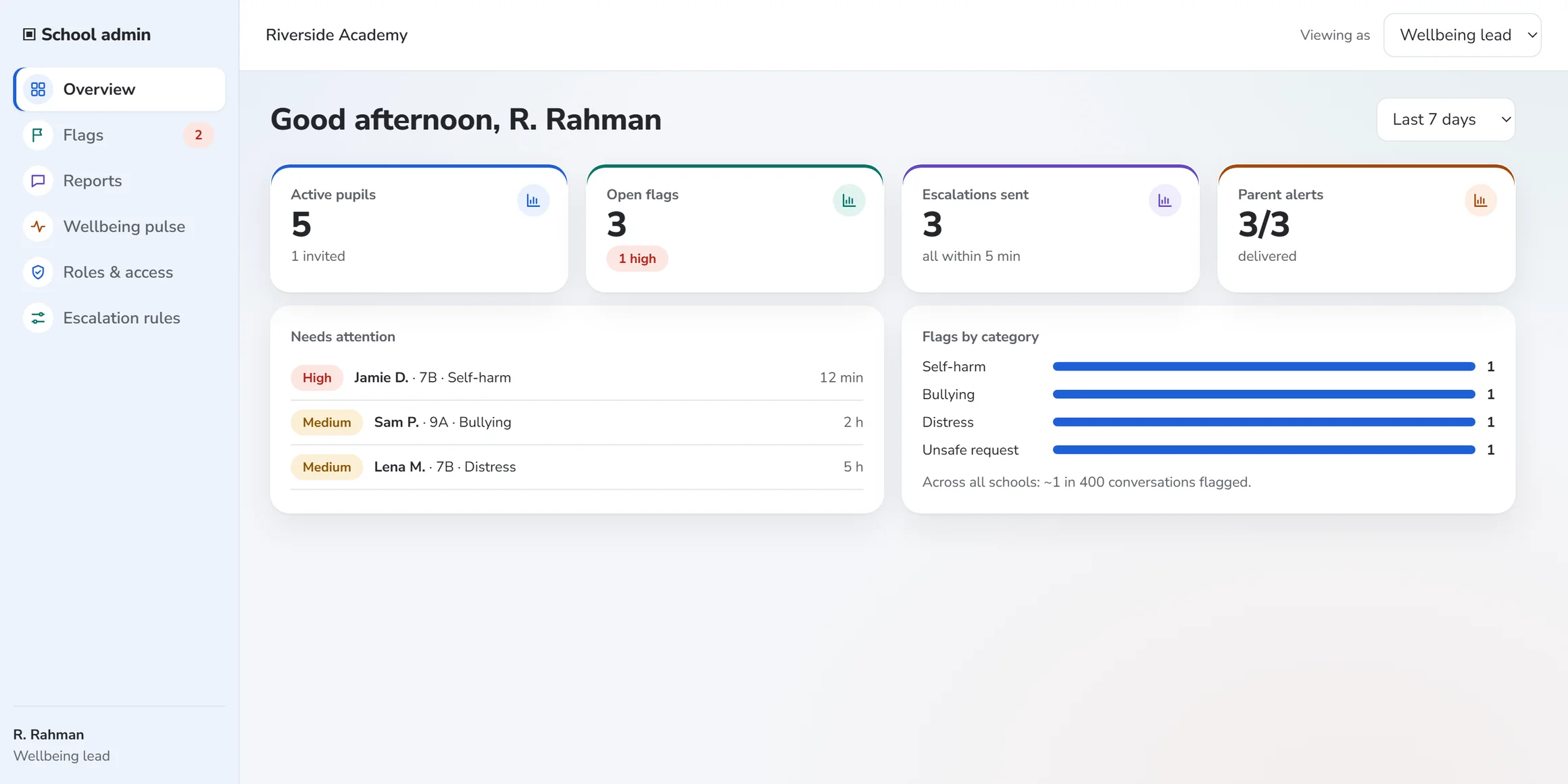
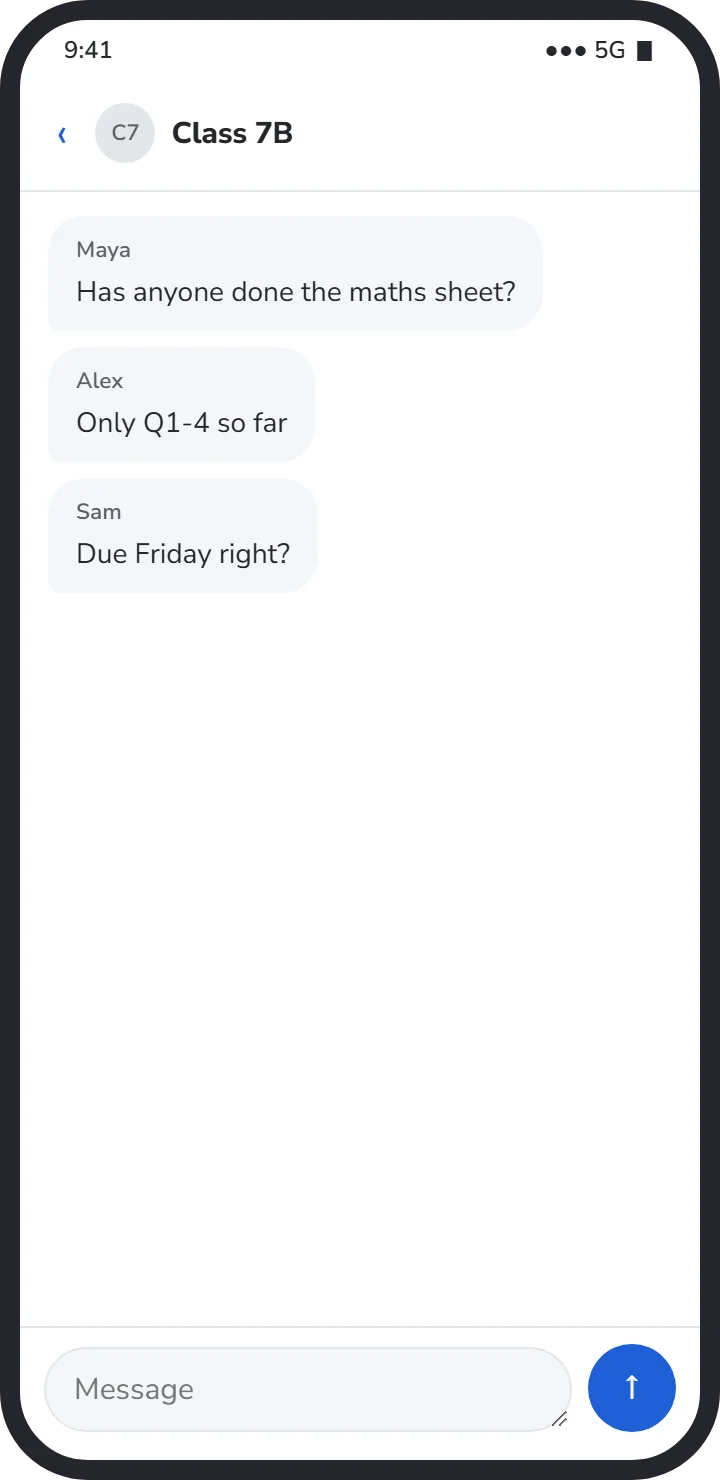
One product, two audiences. A pupil needs an ordinary messenger and an assistant that explains and guides rather than doing the work. Staff need a clear signal when a conversation moves outside normal use, and a short summary instead of reading every chat.
Who is it for?
Pupils use the native app; school staff work through the web admin, and the AI team through the model tooling.
Pupils
A messenger and an AI assistant for their studies, with accounts issued by their school
School staff
Notifications when a conversation goes outside normal use; summaries, full logs only on request
School administrators
Pupils, classes, roles, access levels and rules of use
AI team and the client's domain experts
Test set, eval runs and the gate before any model version goes live
Typography and colours
- Headings and bodyNunito Sans
- Data and screen IDsJetBrains Mono
- Graphite#24262bText
- Clear blue#1f5fd6Links, pupil messages, notices
- Brand pink#e21454One primary action per screen
- Mint#e0f4f0Context and calm states
- Teal#0b7468Context and calm states
- Canvas#f4f6f9Page background
Moderation outcomes
Always a word and an icon, never colour alone.
Preparation
We started with roles, an access matrix and wireframes for every surface, then grew the product in two-week iterations: messenger first, then the school's rules of use, then the tooling that lets a model change safely.
- Concept
- MVP
- Product
- S0
Phase 0: Discovery
Roles, ACL matrix, wireframes, architecture C1–C6
- S1–S6
Phase 1: Foundation
Activation, messaging, roles, assistant through the gateway; closed alpha
- S7–S12
Phase 2: Rules of use
School rules on top of the model, classifier signal, flags, summaries, staff notifications
- S13–S17
Phase 3: Control tooling and eval gate
Test set, runs, gate in CI
- S18–S21
Phase 4: Pilot
A live school, penetration test, go/no-go
- S22–S24
Phase 5: Provider layer
The GPT chat moved behind OpenRouter inside the layer; more organisations
- S25
Phase 6: Stabilisation and handover
Joined by the school, not by sign-up
Pupils cannot register themselves. The school creates the account; the pupil activates it with an invitation code.
- No email or phone number needed
- Organisation-scoped accounts on iOS and Android
- Private messaging with classmates inside the same school
Help with learning, not the finished work
A pupil can't get an essay or a report written for them as part of the course. The assistant explains and guides instead.
- The school's rules of use sit on top of the model's own
- The layer decides what may be asked and answered
- Every request is logged
Notification when a conversation goes off course
When a chat moves outside normal use, the right person at the school is notified. Staff see what happened, not everything a pupil wrote.
- AI summary, the classifier's signal and the gateway's action
- The school decides who is notified about what
- The full log stays locked; opening it needs a reason and is written to the audit log
How it works
Architecture
Pupil apps (C1) talk to the Java message server (C2). Every model-facing request goes through the AI control gateway (C4): it applies the school's rules of use, answers the pupil and, by rule, notifies the right person at the school (C3, C6). Model control tooling (C5) sits beside the gateway.
The control layer
The people using the chat see one assistant; the layer decides where each request goes. It holds the rules of use (what may be asked and answered), logs every request, pins the model version and routes per request type.
A new model version goes live only after the test set passes; until then the previous version keeps serving. The classifier and the definition of acceptable behaviour stay with the client; domain experts who held the non-technical process knowledge signed off behaviour.
Model change without rewriting the product
The process talks to our layer, not to a vendor's API. The chat was built directly on GPT, and moving it behind OpenRouter took real work — which is exactly the lesson. Once it was done, another model became a setting rather than a project. The client chose to stay on GPT, so the switch itself was never needed in production.
It is the same idea as a model-agnostic platform stack: contracts, validation, eval and routing above the provider.
Evaluation gate
- ~400Test questions with expected answers, run against every new model version
Result
We delivered the full product stack, not just an LLM integration: a private messenger, a school admin and a control layer that keeps the model working by the school's rules.
- Native pupil apps for iOS and Android
- Java message server with organisation-scoped accounts
- React school admin with roles and access levels
- Python AI gateway: rules of use, request log, notifications, provider layer
- Model control tooling with an eval gate in CI
| Concern | With the layer |
|---|---|
| Wrong answers | Policies and the test set catch the known failure cases before users see them |
| Silent behaviour change | No version goes live untested; the old one stays until the new one passes |
| Vendor lock-in | Behind the layer, another model is a setting |
| The model's rules, not the school's | The school's rules of use sit on top of the model |
| No visibility | Every request is logged; staff are notified when a chat goes off course |
Technologies
Swift (iOS), Kotlin (Android)
Native pupil apps
Java
Message server / backend
React
School admin
Python
AI control gateway; GPT behind OpenRouter
Model control and training tooling
Client classifier
Integration
Eval scripts / CI
Beyond schools
Employees already paste contracts, code and customer data into AI tools. The same layer could carry over to a company, with the company's own rules of use in place of the school's: what goes out (sensitive content masked or routed to a local model), what comes back (answers checked against policies), audit of who asked what, and the same eval gate on model change.
Because the process only sees the layer, a local open-weight model can be added behind it: sensitive data and routine tasks stay in-house, and only the complex requests go to an external model. In the school project the models were external; the local route is the next step where data must not leave.
Related services
Want to know more?
We can walk you through the control layer and the eval gate in detail.