
AI and Cybersecurity: Why Software Updates and Proactive Monitoring Matter More Than Ever
Frontier AI accelerates vulnerability discovery and abuse. Why enterprises need faster patching, dependency hygiene, SBOM discipline, and proactive security monitoring in 2026.
For a decade, security teams asked whether a vulnerability would be exploited in the wild. In 2026 the better question is how fast an exploit path can be found, packaged, and scaled when attackers (and curious researchers) use frontier AI as a force multiplier.
That shift changes obligations for engineering leaders who run production software: patch cadence, dependency hygiene, and proactive monitoring are no longer hygiene slides. They are core product capabilities. The same applies if you build with AI: assistants in the SDLC, agents with tool access, and customer-facing LLM features all expand the surface you must observe and update.
This article explains why AI raises the bar, what broke in the old «annual pen-test plus quarterly patches» model, and what to put in place on the engineering side. Pair it with our code quality and SDLC controls: the same delivery pipeline that ships features should enforce patch gates, security review, and observable production behaviour.
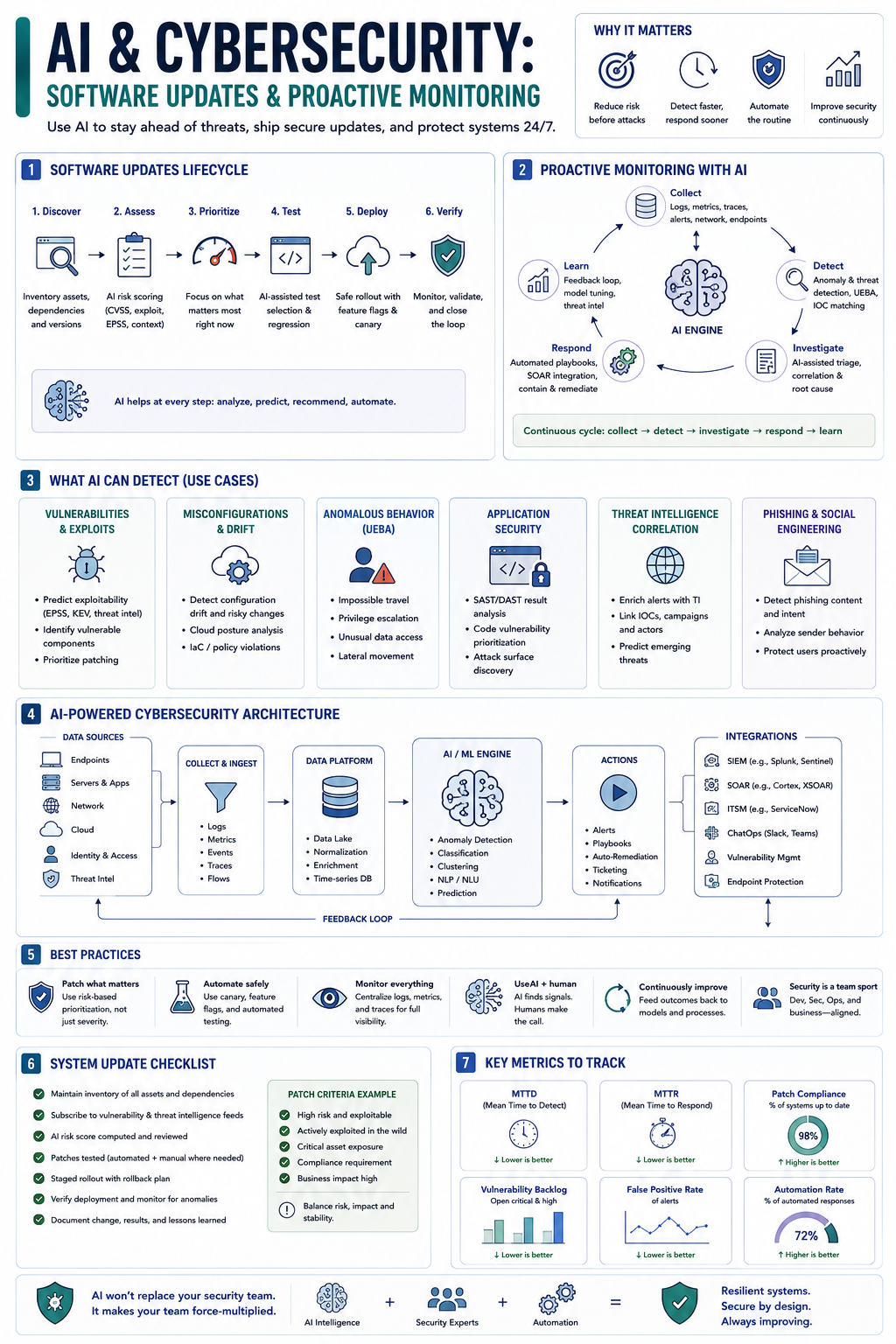
Cybersecurity in 2026: AI compresses the gap between vulnerability disclosure and exploitation on both sides of the fight.
The new asymmetry: offense scales faster than headcount
AI does not replace skilled attackers. It compresses time:
| Activity | Before widespread AI tooling | With AI-assisted workflows |
|---|---|---|
| Code review for bugs | Manual, sample-based | Broader static reasoning, faster triage (also for defenders) |
| Phishing and social engineering | Crafted by hand | High-volume, personalised variants |
| Exploit research | Specialist-heavy | More candidates reach «good enough» faster |
| Defensive patching | Competes with features | Same pressure, but discovery is louder |
Defenders gain productivity too: SAST triage, log summarisation, runbook drafting. The mistake is assuming the benefit is symmetric without changing process. Attackers do not wait for your next release train. If your mean time to patch is measured in months and your dependency tree is opaque, AI-assisted offense only widens the gap.
A signal from the frontier: when AI models become a security policy issue
In June 2026, Anthropic disabled public access to Claude Fable 5 and Mythos 5 days after launch, following a US government export-control directive tied to national security concerns. Anthropic stated that authorities were worried about a jailbreak that could weaken safeguards meant to block misuse for cybersecurity tasks (such as automated vulnerability hunting at scale).
Whether you agree with the policy response or not, the lesson for enterprise engineering is clear: capabilities that speed up security research also speed up abuse. Regulators and customers will ask harder questions about:
- Who can access powerful models and under what logging
- How you prevent tool-using agents from touching production secrets
- How fast you patch when a new class of AI-assisted attack appears
You do not need to run a frontier lab to feel this. If your team uses coding agents, exposes APIs to partners, or ships LLM features, your risk register should treat AI as a pace accelerator, not a magic shield.
Software updates (patching and dependencies) are the first control
Most breaches that make headlines still chain known weaknesses: unpatched libraries, end-of-life runtimes, leaked credentials, misconfigured object storage. AI makes scanning and prioritisation easier for everyone. The response is not fear. It is shorter patch half-life and visible inventory.
What «update discipline» means in practice
- SBOM and dependency inventory for every deployable service (direct and transitive).
- Automated SCA in CI on every merge, with blocking rules on critical CVEs in reachable code paths.
- Runtime baseline: no unsupported JDK, Node, or framework versions in production without a dated exception.
- Patch windows measured in days for critical issues, not quarters.
- Change records that link CVE → ticket → deployment → verification (regression or smoke on critical paths).
Legacy systems are the hardest and the most targeted. A legacy vulnerability analysis programme (inventory, risk scoring, phased remediation) beats a one-time «big bang upgrade» that never ships. That is the engineering spine behind application modernization and ongoing maintenance and support: security work in the rhythm of operations, not only in projects.
AI-specific update surfaces
If you ship AI features, add these to your patch scope:
- Model and prompt versions (rollback plan when jailbreaks or quality regressions appear)
- Agent tool connectors (OAuth scopes, API keys, plugin manifests)
- Vector stores and RAG pipelines (access control patches, embedding service CVEs)
- Inference dependencies (GPU drivers, serving frameworks, gateway plugins)
Treat them like any other production dependency: versioned, scanned, monitored.
Proactive monitoring: detect abuse before it becomes an incident
Patching closes known holes. Monitoring catches unknown paths, misconfigurations, and abuse in progress. AI raises expectations here because:
- API traffic patterns shift quickly when bots and agents call your endpoints
- Insider or partner misuse of AI tools is harder to spot without behaviour baselines
- Fraud and account takeover campaigns scale faster
Layers worth investing in
| Layer | What to watch | Why AI era matters |
|---|---|---|
| Application | Auth failures, privilege changes, unusual export volumes | Automated credential stuffing and scraping |
| API / gateway | Rate anomalies, new clients, scope escalation | Agents and scripts hit APIs 24/7 |
| Dependencies | New CVEs against your SBOM | Faster public disclosure cycles |
| Infrastructure | Drift, open ports, IAM changes | Cloud misconfig still dominates root cause |
| AI / LLM | Jailbreak attempts, tool-call denials, prompt injection signals | New failure mode with real data exfil risk |
| Business logic | Payment, consent, or approval anomalies | Faster social engineering at the edge |
Proactive means alerts with owners and runbooks, not dashboards nobody opens. Pair automated detection with human review on high-impact paths (payments, PII, admin actions). For regulated environments, align retention and access with GDPR and sector rules before you turn on verbose model logging.
The SDLC controls we apply on client engagements (peer review, CI gates, SonarQube, transparent reporting) are the structural counterpart to this article: speed from AI only holds if quality and security gates keep pace.
Building with AI without widening the hole
Teams that adopt coding assistants and internal agents should standardise minimum controls before wide rollout:
- No production credentials in agent context; use short-lived tokens and scoped sandboxes
- Human approval for destructive or cross-system actions
- Audit trails on prompts, tool calls, and outputs for security-sensitive repos
- Separation between public code assistance and systems that touch customer data
- Red-team exercises on agent workflows, not only on web forms
Embed these controls in the same SDLC you use for application code: definition of done, PR checks, release criteria, and post-release monitoring. If you productise AI for customers, scope AI development with security monitoring as a first-class requirement, not a phase-two ticket.
Operating model: vulnerability hygiene inside support
The sustainable pattern we use with clients on long-running systems:
- Baseline (inventory, SBOM, critical-path map)
- Prioritise by exploitability and business impact, not CVSS alone
- Patch in waves (critical weekly, high monthly, strategic quarterly)
- Monitor for recurrence and regression
- Report to product and risk owners in language they can act on
This maps to maintenance and support and application modernization engagements where CVE remediation runs alongside feature work. Waiting for a standalone «security project» to fix critical libraries is how AI-era attackers win.
Engineering checklist (start here)
| Control | Question for your team | Done? |
|---|---|---|
| Inventory | Can we list every production dependency and owner? | |
| Patch SLA | Do we have defined days-to-patch by severity? | |
| CI gates | Does SCA block merges on agreed critical rules? | |
| Runtime EOL | Is any prod runtime past vendor support? | |
| Secrets | Are secrets out of repos and rotated on schedule? | |
| Observability | Do we alert on auth, admin, and data-export anomalies? | |
| AI usage | Are coding agents and LLM features logged and scoped? | |
| Incident runbooks | Can on-call act without hunting for docs? | |
| DR / backup | When did we last test restore on critical data? |
If more than two rows are «no» or «unknown», treat that as technical debt with security interest.
Conclusion
AI did not invent vulnerabilities. It compressed the timeline between disclosure, exploitation, and regulatory attention. The Fable 5 episode is a reminder that capabilities and safeguards are debated in public policy, not only in security forums. For most enterprises the response is grounded: update software faster, know what you run, and monitor like attackers will automate.
Whether you are modernizing a legacy stack or rolling out AI development inside a governed SDLC, the combination of patch discipline and proactive monitoring is the baseline that lets you adopt AI without trading away resilience.
If you want a vulnerability baseline, monitoring design, or a modernization roadmap that includes security waves, tell us about your environment. We help teams ship and operate software where speed and security are measured together.
Disclaimer: This article is general engineering guidance, not legal or regulatory advice. Threat models and compliance obligations depend on your jurisdiction and industry.