
Engagement Models: Pros and Cons for Software Development
Compare fixed price, time and materials, dedicated team, and hybrid engagement models — with a decision framework and links to the Smartym Pro services that fit each model.
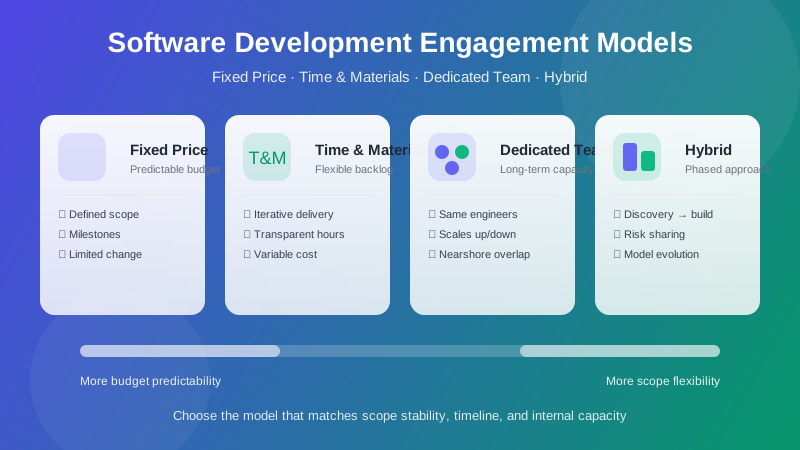
When embarking on a software development project, choosing the right engagement model is as important as choosing the right technology stack. The model defines who owns scope, how budget behaves under change, and how much of your team's time goes into day-to-day delivery management.
Different models offer different levels of control, flexibility, and cost predictability. This guide compares the four approaches we see most often in enterprise and product-led organisations — fixed price, time and materials (T&M), dedicated team, and hybrid combinations — with honest pros, cons, and guidance on which Smartym Pro services align with each path.
Understanding Engagement Models
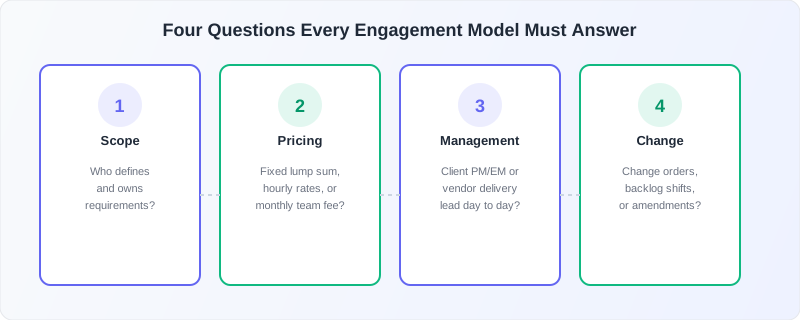
Engagement models define the commercial and operational relationship between a client and a development partner. They answer four questions that procurement and engineering leaders care about:
- Who defines and owns scope? Client, vendor, or shared.
- How is work priced? Lump sum, hourly rates, monthly team fee, or milestone-based.
- Who manages the team day to day? Client product/engineering lead or vendor delivery manager.
- What happens when requirements change? Change orders, backlog reprioritisation, or contract amendments.
The model you choose shapes velocity, quality, transparency, and the kind of partnership you build — not just the invoice format.
Key Factors to Consider
Before selecting an engagement model, evaluate these inputs together (not in isolation):
| Factor | Why it matters |
|---|---|
| Scope stability | Fixed price needs stable scope; evolving products favour T&M or dedicated teams |
| Internal capacity | No in-house PM or tech lead? Avoid models that assume you will manage daily delivery |
| Timeline and budget risk | Predictability vs flexibility — you rarely get both at maximum |
| Duration | Short pilots suit fixed scope; multi-year roadmaps suit dedicated capacity |
| Regulatory or integration complexity | Discovery-heavy work rarely fits a rigid fixed-price box on day one |
| Strategic importance | Core systems deserve continuity; peripheral tools may suit project-based delivery |
If you are still deciding whether to build custom software or buy off-the-shelf, resolve that question first — our guide on custom software development vs off-the-shelf covers the build-or-buy decision before you pick a commercial model.
1. Fixed Price Model
The fixed price model sets a predetermined cost for an agreed scope, timeline, and set of deliverables before development starts in earnest.
Pros of Fixed Price
Predictable budget
- Clear upfront cost for finance and steering committees
- Easier approval in organisations with strict capex/opex rules
- Vendor absorbs overrun risk within the agreed scope
Defined deliverables
- Milestones, acceptance criteria, and documentation expectations are explicit
- Scope creep is visible — it triggers change control, not silent backlog growth
Lower client management load
- Vendor owns delivery planning within the contract boundary
- Suitable when the client has limited engineering management bandwidth
Cons of Fixed Price
Limited flexibility
- Mid-project pivots require formal change requests and re-pricing
- Teams may defer hard questions to stay inside scope rather than optimise the product
Heavy upfront discovery
- Accurate fixed pricing depends on requirements work before build — discovery is not free
- Under-specified scope leads to either padded estimates or delivery conflict later
Quality and innovation pressure
- Deadline and margin pressure can discourage experimentation
- "Not in scope" becomes a recurring phrase when users learn from early releases
When Fixed Price Fits Best
Fixed price works well when:
- Requirements are documented and stable (or stabilised after a paid discovery phase)
- The outcome is a bounded deliverable — an MVP launch, a migration phase, a defined integration
- Budget sign-off requires a single number before work begins
- The client prefers a hands-off relationship for a defined period
Typical Smartym Pro fit: project-based delivery for a scoped product slice — for example a web application with agreed milestones, a startup MVP with a fixed first release, or a defined phase of application modernization (e.g. migrate one bounded context before wider rollout).
Fixed price is a poor default for open-ended product roadmaps where priorities shift every sprint unless you structure work as a series of fixed milestones rather than one monolithic contract.
2. Time and Materials (T&M) Model
Time and materials bills for actual effort — typically per hour or per day per role — against an agreed rate card and reporting rhythm.
Pros of Time and Materials
Maximum flexibility
- Backlog can evolve sprint by sprint without renegotiating the whole contract
- Supports discovery, spikes, and iterative refinement naturally
Transparent effort
- Time reports show where capacity goes — useful for audits and internal learning
- No incentive to hide complexity inside a lump sum
Quality and learning
- Teams can refactor, test deeply, and fix root causes without "out of scope" friction
- Well suited to complex domains (integrations, compliance, performance tuning)
Cons of Time and Materials
Cost uncertainty
- Final spend depends on scope volatility and decision latency on the client side
- Without strong backlog governance, spend can drift upward
Active client participation required
- Product owners must prioritise, answer questions quickly, and accept trade-offs
- Weak client engagement produces slow progress and higher bills
Vendor efficiency varies
- The model rewards honest velocity but requires trust; choose partners with visible metrics (throughput, quality, retention)
When T&M Fits Best
Time and materials suits:
- Evolving product backlogs where market feedback drives priorities
- Complex or poorly mapped systems — legacy exploration, integration mapping, architecture spikes
- Ongoing enhancement after a major release (features, hardening, compliance updates)
- Clients with engineering or product leadership who can steer backlog daily
Typical Smartym Pro fit: sustained engineering on Java backends and integrations, long-cycle modernization programs, or maintenance and support where work queues change month to month. T&M also appears inside hybrid contracts as the flex layer after a fixed-price discovery or MVP phase.
3. Dedicated Team Model
A dedicated development team is a stable group of engineers (and often QA, DevOps, or other roles) who work exclusively on your product for a long engagement — typically billed as a monthly team fee rather than per ticket.
This is the model most clients mean when they search for a dedicated software development team or team extension — though the details matter (see below).
Pros of Dedicated Team
Exclusive focus and continuity
- The same people learn your domain, codebase, and production quirks
- Institutional knowledge accumulates; onboarding churn drops versus rotating contractors
Scalable capacity
- Add or remove roles as roadmap phases change — mobile surge, backend integration push, QA ahead of release
- Faster than hiring FTE in multiple jurisdictions
Strategic partnership
- Metrics shift from "hours spent" to "outcomes per sprint" and release predictability
- Vendor handles HR, equipment, bench coverage, and replacement if someone leaves
Nearshore collaboration
- Teams in overlapping time zones (e.g. Eastern Europe for EU and UK clients) enable real stand-ups and same-day decisions — a model we describe in depth on our dedicated development team page
Cons of Dedicated Team
Commitment and minimum duration
- Ramp-up takes weeks; partners reasonably expect multi-month engagements
- Not economical for one-off tasks or a few days of advice
Client steering responsibility
- You (or your PM/Tech Lead) own backlog priority and acceptance in most formats
- Without clear direction, even a strong team under-delivers against business goals
Cost vs short projects
- Monthly team cost exceeds a small fixed-price task — compare TCO over 12–24 months, not week one
Dedicated Team vs Staff Augmentation
These terms overlap in marketing but imply different expectations:
| Staff augmentation | Dedicated team | |
|---|---|---|
| Typical buyer question | "I need two senior Java developers under my EM" | "I need a stable squad for my product roadmap" |
| Management | Client directs daily work, often task-by-task | Client owns product; vendor manages team HR and performance |
| Continuity | Roles may swap; commodity risk | Same team over quarters; vendor accountable for replacements |
| Best for | Filling known gaps in an existing org | Long-term product delivery or platform evolution |
Smartym Pro offers both role-based augmentation and full functional teams (developers + QA ± DevOps) under the dedicated development team service line — the difference is contract shape and who owns delivery cadence, not whether our engineers are skilled.
When Dedicated Team Fits Best
Choose a dedicated team when:
- You have a multi-quarter or multi-year roadmap, not a one-off brochure site
- You need to scale engineering faster than hiring allows
- The product is business-critical — CRM, payment flows, customer platforms, internal ops tools
- You want overlap with your processes (Jira, GitHub/GitLab, CI, code review standards)
Typical Smartym Pro fit: product engineering across web, mobile, and AI-powered features — with team composition adjusted to stack and phase.

4. Hybrid Models
Most mature client relationships combine models by phase or workstream instead of forcing one label for years.

Common Hybrid Patterns
Discovery (T&M) → delivery (fixed price)
- Paid discovery or architecture phase billed T&M
- Fixed price for MVP or phase-one build once scope is evidenced
- Reduces fantasy estimates while preserving budget clarity for build
Fixed core + flexible backlog (T&M)
- Fixed price for compliance-mandatory baseline (security, audit logging, core APIs)
- T&M for feature backlog driven by user feedback
Dedicated team + milestone bonuses
- Monthly team fee for capacity
- Milestone payments tied to major releases or KPIs (go-live, performance targets)
Dedicated team + project squad for a launch
- Core platform owned by a long-term dedicated team
- Fixed-price sub-team for a one-time migration or major version launch
Benefits of Hybrid Models
- Risk sharing — vendor and client align incentives at phase boundaries
- Honest handling of unknowns — discovery is not hidden inside an artificially low fixed bid
- Portfolio fit — platform team on dedicated model, experiments on T&M or fixed spikes
Hybrid in Practice at Smartym Pro
We often recommend hybrids for enterprise modernization: a fixed-price assessment and pilot strangler route, then a dedicated team to execute migration waves while T&M covers emergent integration work. Similar patterns apply to custom web platforms that start as MVPs and grow into permanent product teams.
Choosing the Right Engagement Model

Decision Framework
Use this matrix as a starting point for workshop discussions — not as a substitute for scoping with an experienced partner.
| Your situation | Likely best fit |
|---|---|
| Stable scope, fixed budget cap, limited PM time | Fixed price (possibly after paid discovery) |
| Active product owner, evolving backlog | T&M or dedicated team |
| 12+ month roadmap, need stable engineers | Dedicated team |
| Gap in specific roles inside your existing team | Role-based augmentation via dedicated team services |
| Legacy system, unknown integration map | T&M discovery, then hybrid |
| Post-launch enhancements and SLAs | T&M or maintenance & support |
Match Model to Project Type
New product or startup MVP — Often fixed price or fixed milestones for v1, then dedicated team or T&M for iteration → Startup development
Enterprise web platform — Hybrid: discovery + fixed MVP, dedicated team for scale → Web application development
Mobile app with ongoing releases — Dedicated squad or T&M with mobile specialists → Mobile app development
Backend, payments, open banking, high-load APIs — Dedicated team or T&M with senior Java/integration engineers → Java & Oracle engineering
Legacy replacement and cloud migration — Phased hybrid with modernization practice → Application modernization
AI features and automation — T&M spikes for PoC; dedicated team when moving to production governance → AI development
Red Flags When Selecting a Model
- Fixed price without credible discovery on a complex domain — expect conflict or cut corners
- Dedicated team sold as unlimited output — capacity is finite; backlog discipline still required
- T&M without reporting or demo cadence — transparency must be contractual
- Staff augmentation without integration into your rituals — "extra hands" that skip stand-ups rarely help
Best Practices for Any Model
Define roles and rituals upfront
- Who owns backlog, architecture decisions, releases, and on-call?
- Which ceremonies are mandatory (planning, demo, retro)?
Agree on change control
- How are scope changes priced and approved under fixed price?
- How is backlog reprioritisation handled under T&M or dedicated team?
Measure outcomes, not only hours
- Sprint goals, defect rates, lead time, release frequency — relevant metrics depend on model but should exist
Plan an evolution path
- Many clients start fixed-price MVP → dedicated team for growth; contracts should anticipate that transition
Review the model periodically
- Quarterly reviews: Is the model still optimal for the next phase?
Conclusion
There is no universal "best" engagement model — only the best fit for your scope stability, internal capacity, timeline, and strategic horizon.
- Fixed price trades flexibility for budget clarity — strong for bounded deliverables when scope is real, not aspirational.
- Time and materials trades cost predictability for adaptability — strong when discovery and iteration dominate.
- Dedicated team trades short-term commodity pricing for long-term velocity and continuity — strong when the product is core to the business.
- Hybrid models reflect how serious software is actually delivered: phased, honest about unknowns, and aligned with evolving priorities.
At Smartym Pro, we help clients select and transition between models as products mature — from scoped web and startup delivery to long-term dedicated teams and modernization programs. Explore the full practice map on our services hub, or read how custom development compares to packaged SaaS if you are still shaping the underlying product strategy.
Ready to discuss the best engagement model for your project? Tell us about your goals — we will recommend a model and team shape matched to your roadmap, not a one-size-fits-all contract.