
GRC Standards and Tools by Product Stage: DORA, NIS2, CSRD, and What Engineering Still Owns
Which GRC standards apply to whom, what they require in practice, and which tool classes fit each product maturity stage - from MVP to regulated EU financial services.
Introduction
Governance, Risk & Compliance (GRC) software does not replace regulation. It helps you map obligations to controls, collect evidence, run workflows, and report to auditors and boards. The hard part for product and engineering leaders is knowing which standards actually apply, what they require in systems and process, and which tool class is worth buying at your current product stage.
This article is a practical map for EU-focused B2B and fintech teams. It covers major standards and regulations (with emphasis on DORA, NIS2, and CSRD), who they apply to, what they demand, and which GRC product categories tend to fit at each stage of product maturity - from pre-revenue SaaS to regulated financial institution.
It is not legal advice. Use it to align compliance, security, and engineering before you buy the wrong platform or miss obligations that live in code, not in a policy library.
Related engineering context: fintech regulatory checklist, PSD3 / PSR readiness, and SDLC quality gates.
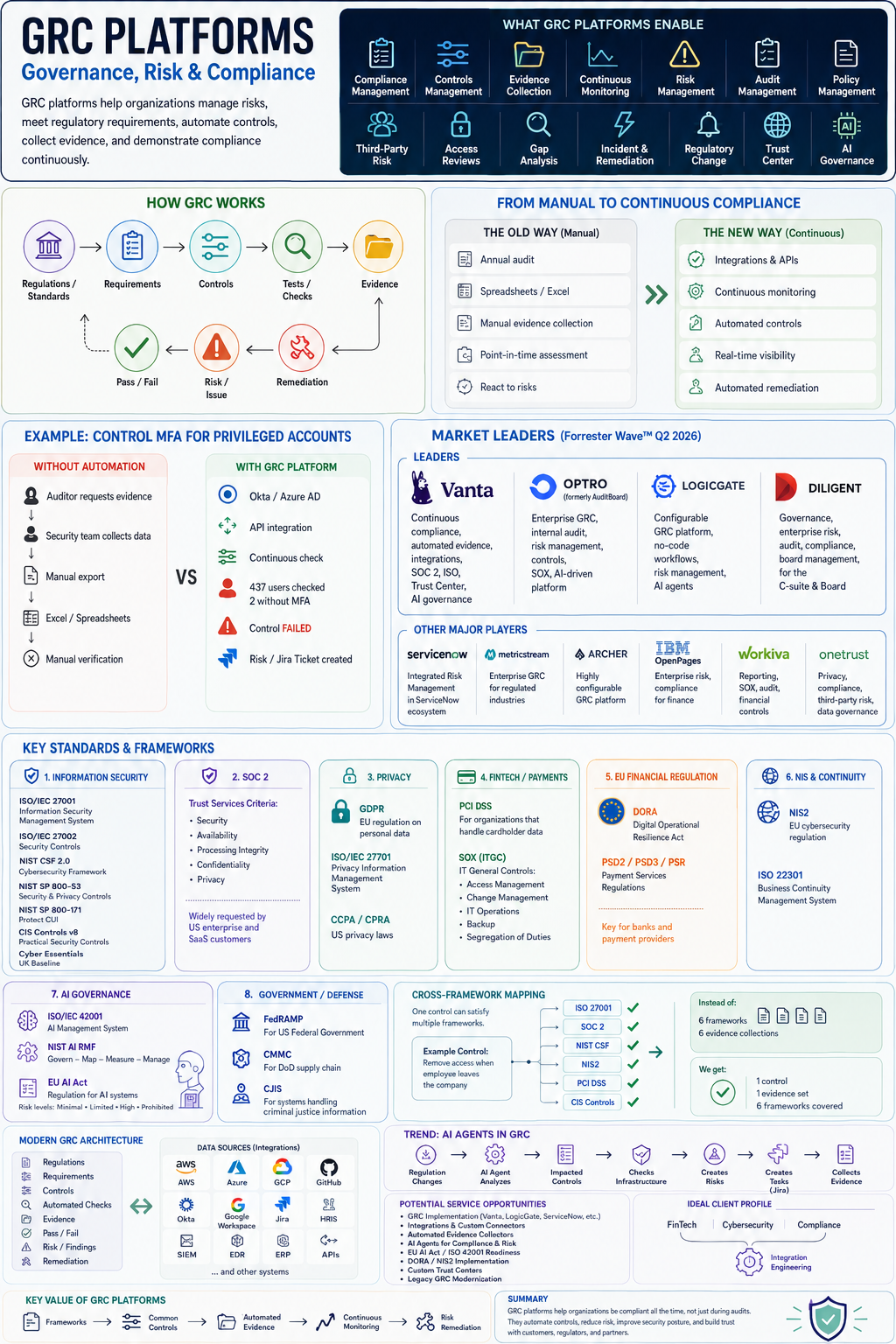
GRC platforms map regulations to controls, collect evidence, and support continuous compliance - from ISO and SOC 2 to DORA, NIS2, and CSRD. Illustrative market and standards overview.
How to read «standards» vs «GRC tools»
| Layer | What it is | Who owns it |
|---|---|---|
| Regulation / standard | Legal or certifiable obligation (DORA, GDPR, ISO 27001) | Legal / compliance + engineering for technical controls |
| Control | Testable requirement («MFA on admin access», «72h breach notification») | Engineering implements; compliance maps and tests |
| GRC platform | Workflow, libraries, evidence, reporting | Compliance / GRC / CISO programs |
| Product code | Auth, logging, encryption, resilience, integrations | Engineering |
GRC tools support ISO, SOC 2, DORA evidence packs. They do not implement payment SCA, core banking logic, or AML screening by themselves.
Standards at a glance: who, what, when
EU operational and sustainability (2024–2026 focus)
| Standard / regulation | Who it applies to (simplified) | What it requires (substance) | Typical GRC modules |
|---|---|---|---|
| DORA (Digital Operational Resilience Act) | EU financial entities (banks, insurers, payment institutions, certain investment firms, critical ICT third-party providers to them) | ICT risk management framework; incident classification and reporting; digital operational resilience testing; ICT third-party risk register and contractual clauses; exit strategies | IRM, TPRM, BCM, incident, audit; ServiceNow IRM, OpenPages, MetricStream, Fusion-class resilience |
| NIS2 | Essential and important entities in sectors listed in the directive (energy, transport, health, digital infrastructure, finance overlap, manufacturing above thresholds, etc.) - member-state transposition defines exact lists | Cybersecurity risk management; incident reporting timelines; supply chain security; management accountability | Cyber GRC, incident, vendor risk; overlaps with ISO 27001 programs |
| CSRD / ESRS | Large EU companies and listed SMEs (phased); non-EU with significant EU activity in scope over time | Double materiality sustainability reporting; ESRS datapoints; governance of sustainability; assurance trail | ESG reporting (Workiva-class), policy/GRC for controls over data |
| GDPR / UK GDPR | Any org processing personal data of EU/UK residents | Lawful basis, DPIA, ROPA, DSR, breach notification, vendor DPAs | Privacy GRC (OneTrust-class), not full enterprise IRM |
| EU AI Act (phased) | Providers and deployers of AI systems by risk class | Risk classification, documentation, human oversight, logging for high-risk; GPAI obligations for model providers | Emerging AI governance overlays; policy + inventory; engineering for logging and controls |
Security and trust (common in B2B sales)
| Standard | Who it applies to | What it requires | Typical GRC / tooling |
|---|---|---|---|
| ISO/IEC 27001 | Any org seeking certifiable ISMS (often B2B SaaS selling to enterprise) | Scope, SoA, risk treatment, Annex A controls, internal audit, management review | ISO-oriented GRC, Vanta/Drata for evidence, audit firms for certification |
| SOC 2 Type II (AICPA TSC) | US-centric SaaS; de facto for global B2B | Security (+ optional availability, confidentiality, etc.); control design and operating effectiveness over a period | Vanta, Drata, Secureframe; AuditBoard for larger SOX-adjacent programs |
| PCI DSS | Entities storing, processing, or transmitting cardholder data | Network segmentation, key management, logging, ASV scans, QSA for higher levels | GRC may store evidence; engineering owns card data scope minimization |
| PSD2 / PSD3 / PSR | Payment service providers, banks, TPPs in EU/UK | Strong customer authentication, secure comms, consent, API access, licensing perimeter | Product and IAM engineering; GRC holds policies and audit trail. See PSD3 article |
Finance and governance (enterprise / US-listed)
| Standard | Who | What | Tool class |
|---|---|---|---|
| SOX 404 / ITGC | US public companies | Financial reporting controls; IT general controls | AuditBoard, Workiva, SAP GRC |
| COSO / ISO 31000 | Enterprise risk programs | Risk process and governance model | Enterprise IRM |
| Basel / ICAAP (banks) | Credit institutions | Capital, risk models, governance | Specialized finance risk (OpenPages, OneSumX) - not startup stack |
What each major EU framework demands in practice
DORA - for financial services and their critical ICT suppliers
Audience: If you hold or seek an EU financial license, or you are a critical ICT third-party provider to those firms, DORA is on your roadmap.
Engineering and architecture must deliver:
- Documented ICT risk management linked to business services
- Incident detection, classification, and regulatory reporting playbooks
- Resilience testing (including advanced testing for larger entities)
- Third-party register: criticality, contracts, exit and substitution plans
- Change and release discipline traceable to production (feeds audit and testing evidence)
GRC tools help with: obligation libraries, control testing schedules, vendor questionnaires, board reporting, issue tracking. They do not replace observability, DR drills, or secure SDLC.
NIS2 - for essential and important entities across sectors
Audience: Broader than finance: hospitals, energy, digital providers, large manufacturing, etc. Check national transposition and sector registers.
Requires:
- Risk analysis and security policies
- Incident handling and notification to authorities
- Business continuity and crisis management
- Supply chain security (vendor assessment)
- Management training and liability (member-state dependent)
GRC fit: cyber GRC + TPRM + incident modules. Often combined with ISO 27001 as the control baseline.
CSRD / ESRS - for corporate sustainability reporting
Audience: Large EU corporates and expanding cohort of listed and in-scope companies - often not the same buyer as CISO, but CFO / sustainability / legal.
Requires:
- Materiality assessment (impact and financial)
- ESRS-aligned metrics and narrative
- Governance over sustainability data (controls, sources, audit trail)
GRC fit: ESG reporting platforms and narrative tools (Workiva-class); GRC policy modules for data governance over ESG inputs. Product engineering is involved when sustainability data comes from operational systems (supply chain, energy, HR).
Product maturity stages and useful GRC classes
Match spend to commercial pressure and regulatory perimeter, not to «buy Archer because the bank next door did».
Stage 0 - Pre-product / MVP, no enterprise buyers yet
Typical profile: Founders, small team, no regulated license, no enterprise security review.
Standards in scope: Usually none mandatory beyond GDPR basics if you have EU users.
What to do without a GRC platform:
- Privacy policy, minimal ROPA, vendor list
- Baseline secure SDLC (secrets, backups, access)
- No card data in scope if avoidable
Tools (lightweight): Policy docs, shared password manager, cloud native security defaults. Skip enterprise IRM.
Stage 1 - B2B sales, security questionnaires, first SOC 2 / ISO path
Typical profile: SaaS selling to mid-market; customers send SIG / CAIQ / custom 200-question forms.
Standards in scope: SOC 2 (US buyers), ISO 27001 (EU/enterprise), GDPR, sometimes PCI if any card touch (prefer redirect/tokenization).
Useful product classes:
| Class | Examples (illustrative) | Why now |
|---|---|---|
| Automated security compliance | Vanta, Drata, Secureframe, Sprinto | Evidence collection, control monitoring, auditor collaboration |
| Privacy management (if PII-heavy) | OneTrust, TrustArc (modules) | ROPA, DPIA, DPA workflow |
| Ticketing / docs | Jira, Confluence | Enough until volume justifies GRC |
Engineering still owns: MFA, logging, encryption, vulnerability patching, access reviews implemented in systems - see cybersecurity and patching.
Avoid: Full ServiceNow IRM / OpenPages / Archer - cost and implementation time exceed the problem.
Stage 2 - Regulated or regulated-adjacent fintech (EMI, PI, insurtech, BaaS partner)
Typical profile: License application or live payment / e-money / investment perimeter in EU/UK; partner bank audits.
Standards in scope: PSD2/PSD3, AML (process + monitoring vendors), GDPR, PCI if card, national conduct rules, often ISO 27001, approaching DORA if in financial entity scope.
Useful product classes:
| Class | Examples (illustrative) | Why now |
|---|---|---|
| Security compliance automation | Vanta/Drata (still valid) + stronger custom evidence | License audits want traceability |
| TPRM / vendor risk | Whistic, ProcessUnity, ServiceNow VRM, OneTrust TPRM | DORA and partner due diligence |
| Policy / ethics | NAVEX, SAI360 (modules) | Conflicts, whistleblowing, policy attestations |
| Regulatory reporting (if bank-grade) | Regnology, OneSumX | Separate from policy GRC - reporting to supervisors |
Engineering owns: API security, SCA, ledger correctness, reconciliation, AML integration, incident runbooks in production.
Smartym angle: Fintech software development and open banking integration - build the systems GRC will reference.
Stage 3 - Scale-up with enterprise and financial institution customers
Typical profile: Selling to banks; DORA flows down via ICT third-party contractual clauses; dual SOC 2 + ISO; complex vendor graph.
Standards in scope: Customer-driven ISO 27001, SOC 2, DORA (as supplier), NIS2 (if you are in scope as essential entity), PCI, sector questionnaires.
Useful product classes:
| Class | Examples (illustrative) | Why now |
|---|---|---|
| Mid-market configurable GRC | LogicGate, Hyperproof, Centraleyes | Cross-framework mapping without full Archer program |
| Enterprise IRM (if budget and team) | ServiceNow IRM, MetricStream, OpenPages | Single risk and control model across entities |
| Audit management | AuditBoard (if SOX or heavy IA) | Internal audit and external coordination |
| BCM / resilience | Fusion, ServiceNow BCM | DORA testing and continuity evidence |
Integration work becomes the project: IdP, CMDB, cloud APIs, HRIS, ticketing - GRC value is in automation, not the UI.
Stage 4 - Licensed financial institution or large corporate
Typical profile: Bank, insurer, large PI; group structures; board and regulator reporting.
Standards in scope: DORA fully, Basel/insurance rules, SOX (if listed US), CSRD, NIS2, national law, ISO 22301 BCM, internal COSO ERM.
Useful product classes:
| Class | Examples (illustrative) | Why now |
|---|---|---|
| Enterprise IRM / GRC suite | ServiceNow, OpenPages, Archer, MetricStream, SAP GRC | Group-wide risk, controls, issues |
| Regulatory reporting | Regnology, Wolters Kluwer OneSumX | Prudential and statistical reporting |
| Connected reporting | Workiva | CSRD, SOX narrative, linked data |
| Specialist finance risk | OpenPages, OneSumX | Model risk, capital - beyond generic GRC |
Engineering: multi-year programs for core modernization, resilience testing automation, and controlled change - GRC tracks; systems prove.
Summary matrix: standard → stage → tool class
| Standard | Usually relevant from stage | Primary tool class |
|---|---|---|
| GDPR | 0+ | Privacy module or lightweight ROPA |
| SOC 2 / ISO 27001 | 1+ | Automated security GRC (Vanta-class) |
| PCI DSS | 1+ if card data | Engineering scope + evidence in GRC |
| PSD2 / PSD3 | 2+ fintech | Engineering + policy GRC for audit trail |
| DORA | 2+ (as FI or ICT TP) | IRM + TPRM + BCM |
| NIS2 | 2–4 (sector dependent) | Cyber GRC + incident |
| CSRD / ESRS | 4 (large corp) | ESG reporting + governance |
| SOX / ITGC | 4 (US listed) | AuditBoard / Workiva / SAP GRC |
Common mistakes by stage
- Stage 1 buying enterprise IRM - 18-month implementation while customers wait for SOC 2.
- Stage 2 treating Vanta as DORA program - checkbox compliance without TPRM, testing, or incident taxonomy.
- Assuming GRC implements PSD2 SCA - it documents and evidences; product implements.
- Ignoring ICT third-party status - your SaaS may be in scope for DORA via bank contracts before you hold a license.
- CSRD bought by CISO - wrong sponsor; ESG data model is finance/sustainability-led.
What Smartym Pro can help with
We do not resell GRC licenses. We help engineering teams build and integrate what standards actually require:
- Regulated fintech and payment products - APIs, auth, audit logs, resilience
- Integrations between your stack and GRC/evidence tools (cloud, IdP, ticketing)
- Modernization of legacy cores where controls and testing must improve for DORA or ISO
- AI features with governance hooks (inventory, logging, human review) aligned with emerging AI Act practice
Start from fintech regulatory checklist if you are scoping a build. For open banking and payment integration, see open banking services. To discuss your stage and architecture, get in touch.
FAQ
Do we need a GRC platform to get ISO 27001?
No. You need an ISMS and auditable controls. Many firms use GRC or automated compliance tools to organize evidence; some use structured docs and spreadsheets at small scale.
Is DORA only for banks?
No. It covers multiple financial entity types and, separately, critical ICT third-party providers. SaaS vendors to banks should expect DORA-style contract clauses.
NIS2 vs DORA - which wins?
If both apply, you must meet both. They overlap on cyber and incident themes; DORA adds finance-specific ICT resilience and testing depth.
When is CSRD relevant to a fintech startup?
Often not until group size or listing triggers CSRD scope. Enterprise customers may still ask for ESG disclosures via procurement, separate from CSRD.
Can one tool cover everything?
Rarely at enterprise scale. Expect security automation + IRM + privacy + ESG reporting over time, integrated rather than one monolith.
Conclusion
GRC standards differ by who you are (SaaS vendor, licensed PI, bank, essential entity) and product stage. DORA, NIS2, and CSRD are the EU headlines for 2025–2026, but most teams feel SOC 2, ISO 27001, GDPR, and PCI first through sales and licensing.
Choose tool classes that match stage: lightweight automation early, TPRM and IRM as financial and enterprise pressure grows, ESG and regulatory reporting when corporate scope demands it. Whatever you buy, engineering still owns the controls that run in production.
Mapping your stage to obligations and architecture? Tell us about your product and perimeter.
General guidance on compliance-aware software delivery - not legal, audit, or licensing advice. Confirm applicability of regulations with qualified counsel and supervisors.