
How to Modernize a Java System: Upgrade in Place, Strangle, or Change the Stack
A practical ladder for modernizing critical Java backends: stabilize, LTS uplift, strangler, and when a stack change is actually justified.
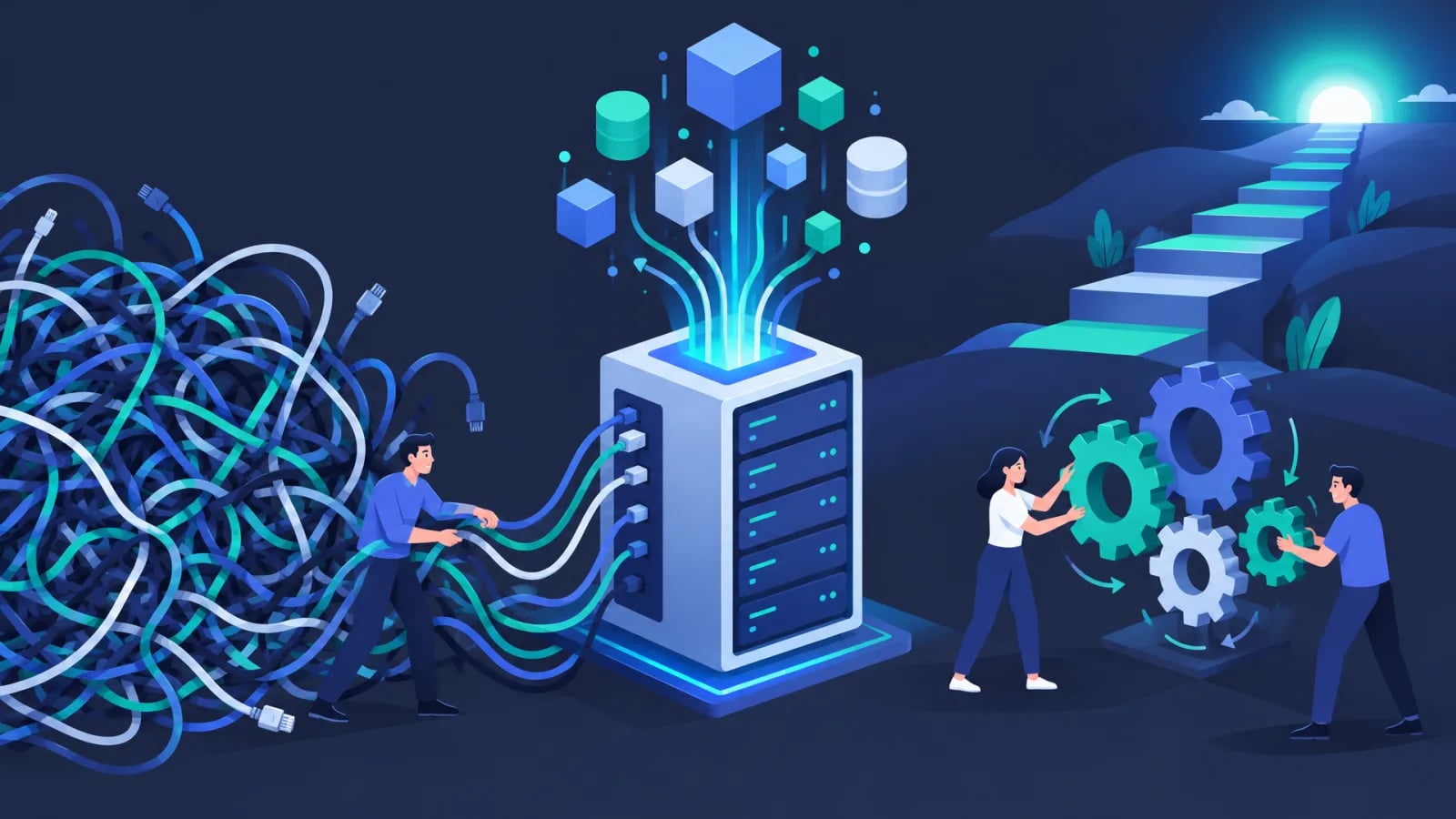
Critical Java systems rarely fail because the language is “old”. They fail because nobody trusts the next change: weak tests, tribal knowledge, EOL runtimes, and a board slide that says “rewrite in microservices”. If you need to modernize legacy Java applications, the useful question is not “which language is trending”. It is which rung of the ladder you are actually on.
This guide is for platform owners and CTOs with revenue-critical Java backends. It pairs with application modernization as the programme frame and Java engineering as the delivery craft.
Three false starts
- Microservices first. Splitting without a dependency map multiplies outages.
- Change language for speed or safety. Without a baseline and a threat model, you trade known debt for unknown debt.
- Stay on Java 8 forever. Quiet growth in CVE exposure and hiring friction is still a decision.
The alternative is a sequence: understand, stabilize, uplift, then evolve boundaries. Full rewrites stay an exception with an executive sponsor.
Start with AS-IS, not with a rewrite pitch
Before any “we will redo it”, inventory:
- Modules, build system, JDK, frameworks, shared libraries
- Batch jobs, integrations, and shared databases
- Blind spots: money and auth paths without tests; documentation only in people’s heads
AI can speed up mapping code and drafting docs. It does not own cutover. If the system is too opaque to touch, a scoped AS-IS pack is a better entry than a year-long rewrite proposal. Production support and reliability may need to come first: see maintenance and support when the lights must stay on while you plan.
A modernization ladder
| Level | What you do | Typical outcome |
|---|---|---|
| 0. Stabilize | Support rhythm, CVE hygiene, minimum observability | Safe to change anything at all |
| 1. Runtime uplift | Move to a supported LTS (often 17 or 21) | Lower platform risk, same language |
| 2. Framework uplift | Spring Boot / EE and Jakarta migrations | Modern tooling, same language |
| 3. Strangler | Extract a bounded context or edge API | Evolution without big bang |
| 4. Selective rewrite | One domain on a new service or stack | Only where ROI is proven |
| 5. Big-bang rewrite | New stack end to end | Exception path |
Most programmes should expect to live in levels 1 to 3. Level 5 needs a separate business case, not a conference talk.
When keeping the Java stack is the right call
Keep Java when:
- The team and hiring pool are already strong on Java and Spring
- Pain is runtime debt and operations, not “the language blocks the product”
- Integrations (messaging, databases, batch) are battle-tested
- Assistants and tooling already amplify the team on this corpus
In those cases, upgrade in place beats a fashion migration. Productivity often rises from better JDK, libraries, and CI, not from teaching everyone a new runtime.
Practical steps for an LTS uplift
- Pick a target LTS and a policy (“nothing below X in production”).
- Build on CI with the new JDK before production cutover.
- Update dependencies in waves; isolate Jakarta namespace work.
- Cover critical paths and integration contracts with regression tests.
- Prefer canary or parallel run for high-risk surfaces.
- Do not combine major JDK, major framework, and domain rewrite in one release.
A dedicated article on planning large upgrades sits next to this one in the backlog (Migrate to Java 17 or 21). The principle is the same: sequence risk, do not stack it.
When partial redesign (strangler) pays off
Use a strangler when you need new capability at the edge (BFF, new API channel) while the core still earns money. Isolate a hot module with clear contracts. Avoid “everyone shares one database forever” without an ownership plan.
Here “redesign” means boundaries and contracts, not prettier class names. That is also where application modernization programmes usually spend their budget wisely.
When changing the stack is justified
Change language or primary runtime only when several conditions hold:
- The ecosystem or runtime is effectively unsupported
- You cannot hire for the current stack in your target geography
- A new product line needs a different runtime and the boundary is clean
- You have proven a performance or cost ceiling that architecture and profiling on Java cannot clear
Weak reasons: “everyone moved to Go”, “AI generates TypeScript more nicely”, “microservices therefore new language”. Dual-stack tax lasts for years. You lose playbooks and library maturity. Scope creep kills product delivery while the rewrite runs.
Decision tree
Critical Java system?
  → No AS-IS map? → AS-IS / stabilize first
  → Runtime EOL or CVE pressure? → Prefer LTS uplift (keep stack)
  → Need new capability at the edge? → Strangler / BFF (keep core Java)
  → One domain must change language? → Prove ROI; rewrite one slice only
  → Full stack change? → Exception path with executive sponsor
How Smartym Pro helps
We modernize Java systems as engineering work with ownership on cutover, not as a language sales pitch. Typical path: clarify AS-IS, stabilize if needed, uplift LTS and frameworks, then strangler where the product needs it.
- Craft and delivery: Java and Oracle engineering
- Programme framing: application modernization services
- Keep production calm: maintenance and support
Key takeaways
- Most Java modernization value is in stabilize, LTS uplift, and strangler, not in changing language.
- AS-IS comes before rewrite slides.
- Change stack only with supportability, hire, or proven ROI reasons.
- Never combine JDK, framework, and domain rewrite in one risky release.